


Menards Alternatives: Shop by Task, Use PriceLows™ for US Budget Buyers
Most Menards alternatives fall into four buckets: national big-box chains for bulk lumber and consistent stock, neighborhood hardware stores for quick repairs, rural or outdoor specialists for ranch and yard needs, and online retailers for the lowest prices without a store trip. For budget shoppers, PriceLows™ is the strongest online substitute, especially for garage storage, yard gear, and home essentials. The checklist and product picks below help you match the right retailer to your actual project.
TL;DR:
- Big-box retailers like Home Depot offer the most inventory certainty for bulk lumber and multi-week renovation projects, especially within their extensive store networks.
- Neighborhood hardware stores provide quick access to repair parts and small tools, saving time despite typically offering higher per-unit prices.
- Online retailers like PriceLows™ excel for budget-conscious shoppers seeking storage solutions, shipping protection, and the best total landed cost for garage or yard essentials.
- Delivery is preferable for heavy or bulky items, while curbside pickup suits same-day needs when stock and vehicle capacity are confirmed beforehand.
- Price matching varies widely; always compare total costs after shipping and taxes, and read return policies carefully to avoid hidden fees or restrictions.
Table of Contents
- What Retailer Types Replace Menards?
- How Do You Compare Menards Alternatives?
- When Does Online Shopping Beat a Store Trip?
- Where Does PriceLows™ Fit for Budget Shoppers?
- Author And Proof: Why This Guide Is Trustworthy
- How Do Loyalty Programs Compare?
- What About Price Matching And Returns?
- Can You Find Eco-Friendly Or Specialty Materials?
- Practical Advice For Three Shopper Types
- Shop Garage Storage And Home Essentials At PriceLows™
- Sources
- FAQ
What Retailer Types Replace Menards?
Menards built its reputation on a Midwestern footprint of roughly 355 stores spread across about 15 contiguous states, according to Specrom’s store location data. If you live outside that region, you never had a Menards to begin with, which means “alternative” really means “primary hardware store.” Either way, the retailer types below cover different jobs, and knowing which one fits your project saves both money and trips.
National big-box chains. These are the largest operators by store count and inventory depth. Home Depot alone reported 2,359 stores at the end of fiscal 2025, giving it a scale advantage for bulk lumber, consistent SKU availability, and same-day pickup in nearly every metro area. If you’re framing a deck or buying appliances on a deadline, this scale matters more than shaving a few dollars off a per-item price.
Neighborhood hardware stores. Smaller, often independently owned, these shops win on speed and staff knowledge for one-off repairs: a specific bolt, a replacement washer, a can of the exact paint color you already used. They rarely beat big-box pricing on volume purchases, but they save you the 40-minute drive.
Rural and outdoor specialists. Farm supply and ranch stores fill a gap that neither Menards nor the big chains cover well: livestock feed, fencing, tractor parts, and seasonal outdoor gear. If your project involves acreage rather than a subdivision lot, these retailers often carry items the others simply don’t stock.
Online and omnichannel sellers. These retailers skip the store overhead entirely and compete on price and shipping. They work best for standardized items you don’t need to see in person first, like storage cabinets, lighting fixtures, or garage organization systems.
A few practical takeaways for matching type to task:
- Bulk lumber or a multi-week renovation: national big-box, for inventory certainty
- A single repair part or small tool: neighborhood hardware, for speed
- Ranch, fencing, or acreage needs: rural/outdoor specialists
- Garage storage, décor alternatives for your home or yard equipment on a budget: online retailers like PriceLows™
How Do You Compare Menards Alternatives?
Comparing store names gets you nowhere. Comparing the actual cost and reliability of getting your project done gets you somewhere. Here’s the process that actually works:
- Build your exact basket first. List every item, quantity, and spec (board length, cabinet dimensions, wattage) before you start pricing anything. Lowe’s own guidance on comparing retailers starts here for a reason: a vague list makes every price comparison meaningless.
- Check local inventory before you drive anywhere. A “great price” online means nothing if the item is backordered for three weeks.
- Calculate delivery and pickup costs separately from the item price. Free shipping on a $40 item beats a $35 item with a $12 delivery fee.
- Factor in rebates, coupons, and return terms. A mail-in rebate that takes eight weeks to process isn’t really a discount if you needed the cash flow now.
Retailers themselves identify the dimensions that matter: location, assortment, price, in-stock levels, customer service, delivery speed, shipping cost, and pickup convenience, per Lowe’s SEC filing. Weight those differently depending on your project. A lumber-heavy renovation should weight in-stock levels and assortment heavily; a small repair should weight price and service; yard equipment often comes down to delivery speed and total shipped cost.
Watch for red flags: hidden delivery surcharges that appear at checkout, stock levels that show “in stock” online but aren’t at your local branch, and return policies with restocking fees buried in the fine print.
Pro Tip: Screenshot your cart total before entering any promo code, then compare it against the final total after shipping and taxes. That gap is the real price you’re paying, not the sticker price on the shelf.
When Does Online Shopping Beat a Store Trip?
Delivery wins when items are heavy, bulky, or simply unavailable near you. A locking storage cabinet that weighs 80 pounds is a different proposition to load into a sedan than to have dropped at your garage door. Delivery also makes sense when a retailer bundles shipping costs into the sticker price, which removes the guesswork entirely.
Curbside pickup earns its keep when you need something today and you’ve already confirmed three things: the item is actually at that location (not just “in the region”), the hold window before it goes back on the shelf, and whether your vehicle can fit what you’re picking up. Skipping that last check is how people end up strapping lumber to a roof rack in a parking lot.
Shipping cost and speed change your real project price more than most shoppers expect. A cheaper item with slow, unprotected shipping can end up costing more once you factor a damaged-in-transit replacement. That’s where shipping protection plans start to matter, since they remove the “what if this arrives broken” tax from your budget.
- Choose delivery for heavy or bulky items with no easy local pickup
- Choose curbside pickup for same-day needs, after confirming stock and hold time
- Always compare total shipped cost, not the listed item price alone
Store scale affects what’s actually available near you. Home Depot’s 2,359-store footprint means most U.S. shoppers have a same-day pickup option within a reasonable drive. Regional chains and online-only retailers fill the gaps where that isn’t true, which is a big part of why online alternatives have moved from a backup option to a first choice for many households.
Where Does PriceLows™ Fit for Budget Shoppers?
PriceLows™ has spent 15 years focused on savings for families furnishing the home, yard, and garage, with a catalog built around a simple idea: vetted, affordable products without the store overhead.
For shoppers replacing a typical Menards garage-storage run, the catalog lines up closely with what you’d have bought in-store:
- The Black Locking Storage Cabinet With Shelves Heavy Duty solves the “I need to lock up tools and chemicals away from kids” problem with adjustable shelving inside a heavy-duty frame.
- The Black Metal Storage Cabinet With Lock And Shelves Garage covers general garage organization for households consolidating scattered bins and shelves into one secured unit.
- The Black Metal Storage Cabinet With Locking Adjustable Shelves adds shelf flexibility for garages storing oddly shaped items, from paint cans to power tool cases.
Before you order any of them, measure your actual garage space, not just the wall you think it’ll go against. Check the shipping terms on the product page, and read the existing reviews for notes on assembly time and packaging quality. Readers who want a broader DIY comparison can also check PriceLows™'s Lowe’s alternatives roundup for how online options stack up against big-box competitors.
Author And Proof: Why This Guide Is Trustworthy
Thane Holland covers budget home, yard, and garage retail for PriceLows™, including direct comparisons like the Lowe’s alternatives guide, which examines how online and big-box options stack up on price and delivery.
PriceLows™ backs its claims with 15 years of stated savings history, free shipping on most orders, and 100% shipping protection. Before you buy from any retailer, including PriceLows™, check the specific product page for current shipping terms and read recent customer reviews. Claims are only as good as what shows up on your porch.
How Do Loyalty Programs Compare?
Menards is known for its rebate system, a percentage-back mail-in or store-credit offer tied to specific purchases rather than a points-based membership. It rewards patience: the rebate often takes weeks to process, and the money typically comes back as store credit rather than cash.
National big-box competitors tend to run more traditional loyalty structures, sometimes layered with pro-contractor pricing tiers, cardholder discounts, and app-based coupon stacking. Neighborhood hardware stores vary widely. Some run simple punch-card style discounts; many have no formal program at all, relying on personal service instead of points.
Online retailers approach loyalty differently. Instead of a rebate that takes two months to arrive, the value shows up upfront in the listed price, plus structural perks like free shipping and shipping protection that apply automatically rather than requiring a rebate form. PriceLows™'s model leans this direction: savings are built into pricing and backed by free shipping and shipping protection on most orders, rather than asking shoppers to file paperwork and wait.
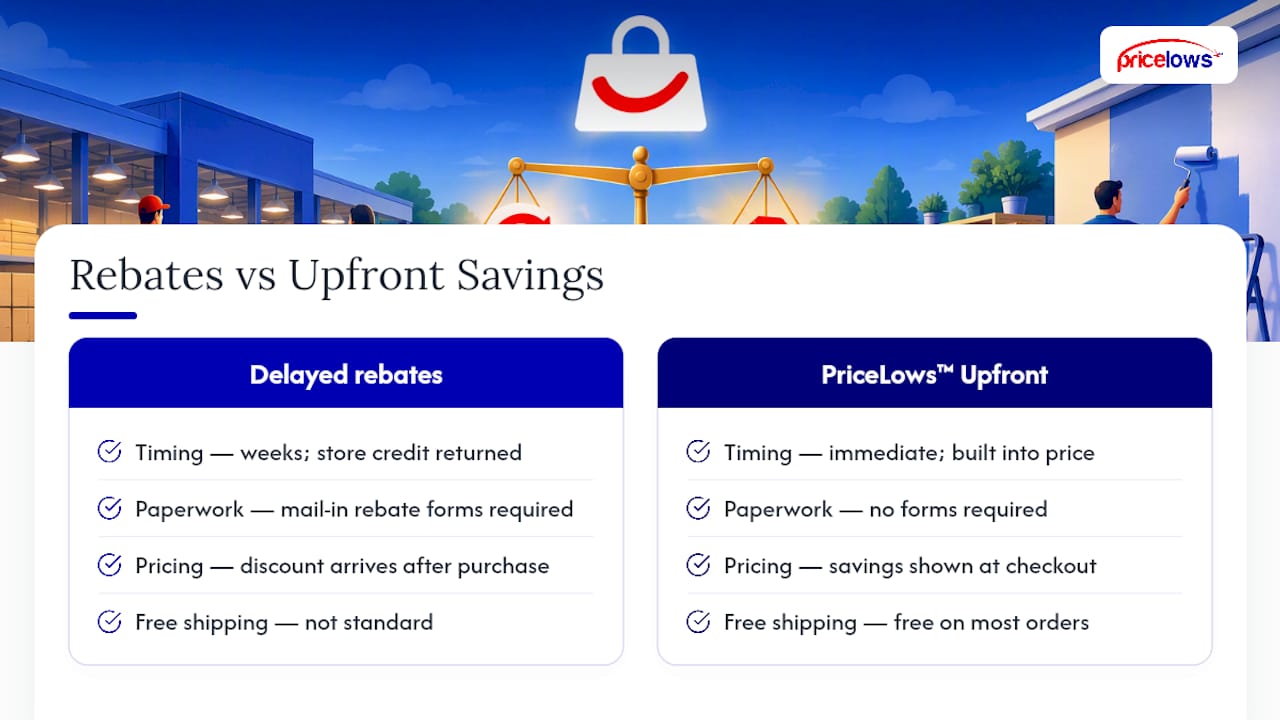
If you value getting your discount immediately and hate mail-in forms, weigh that heavily. If you buy from the same store constantly and don’t mind the wait, a rebate program can add up over a year. Neither approach is wrong, but they suit different shopping habits, and knowing which one matches yours saves real frustration down the line.
What About Price Matching And Returns?
Return policies vary more than shoppers expect, and the fine print is where the real differences live. Big-box national chains generally offer the most generous return windows, often 90 days or more on most items, with in-store processing for online purchases. That flexibility comes from scale: with thousands of locations, absorbing returns is easier to manage.
Neighborhood hardware stores tend to have shorter windows and stricter conditions, since they can’t absorb returned inventory as easily. Rural and outdoor specialists often split policies by category. Feed and perishable goods are frequently final sale, while hardware and equipment follow standard return rules.
Price matching is where things get genuinely inconsistent across the industry. Some retailers match a competitor’s listed price on an identical item; others only match their own past sales or online listings against their own stores. The practical move is to screenshot the competing price and ask before you buy, not after, since post-purchase price-match requests get denied far more often than pre-purchase ones.
For returns specifically, read the policy on the exact product page you’re ordering from, since many retailers vary terms by category. Items with shipping protection, the kind PriceLows™ includes on most orders, typically simplify this: damage or loss in transit gets handled without you needing to invoke a separate return process at all.
Can You Find Eco-Friendly Or Specialty Materials?
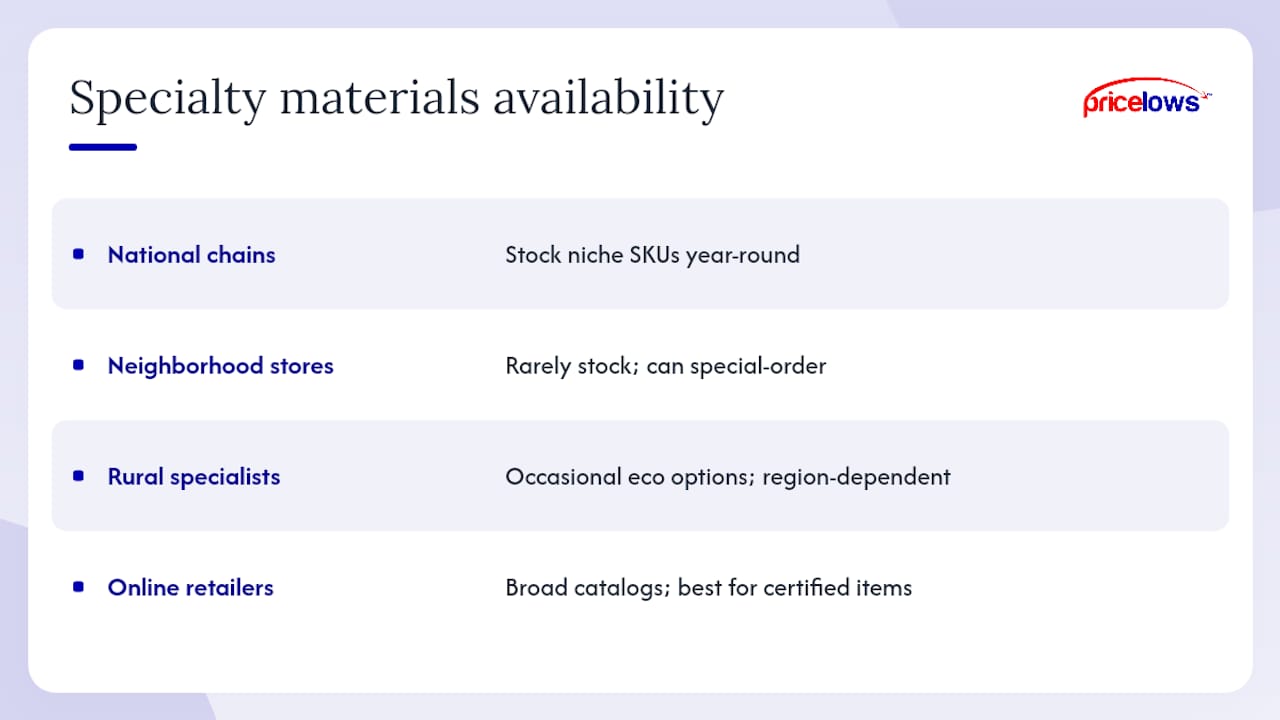
Specialty materials are one area where retailer type really does dictate your options. Reclaimed wood, low-VOC paints, and FSC-certified lumber show up more consistently at retailers that have built dedicated sustainability lines, and availability tends to concentrate at the larger national chains with the purchasing scale to stock niche SKUs year-round.
Neighborhood hardware stores sometimes special-order specialty materials but rarely stock them on shelves, since shelf space for low-turnover items is expensive for a small footprint. Rural and outdoor specialists occasionally carry eco-conscious fencing and composite decking, but the selection depends heavily on the individual store’s regional supplier relationships.
Online retailers fill a different niche here. Because they aren’t constrained by physical shelf space, catalogs can include specialty and eco-conscious product lines without the stocking risk a brick-and-mortar location takes on. If you’re hunting for a specific certified material rather than a general category, searching online first and confirming specs before ordering usually beats driving store to store hoping one has it.
The honest takeaway: no single retailer type dominates specialty materials. Match the search to the source, check certifications on the product listing itself rather than assuming a “green” label means anything specific, and don’t be afraid to call ahead if a physical store’s website doesn’t list detailed material specs.
Practical Advice For Three Shopper Types
Contractors and pros should prioritize supply consistency over price. A national chain’s inventory depth beats saving a few dollars per board when a job stalls waiting on backordered material.
Suburban DIYers tackling weekend projects usually do best with neighborhood hardware for small parts and same-day pickup for anything bigger, minimizing drive time between two trusted spots.
Budget-focused online shoppers should calculate total landed cost, item price plus shipping plus protection, before comparing anything else. For this group, PriceLows™ is the recommended starting point.
— Thane Holland
Shop Garage Storage And Home Essentials At PriceLows™
If you’re replacing a Menards run with something that doesn’t require a store trip, PriceLows™ gives you the lower total cost that budget shoppers are actually after: no membership rebate to file, no store drive to plan around, just vetted pricing with free shipping and 100% shipping protection built into most orders.
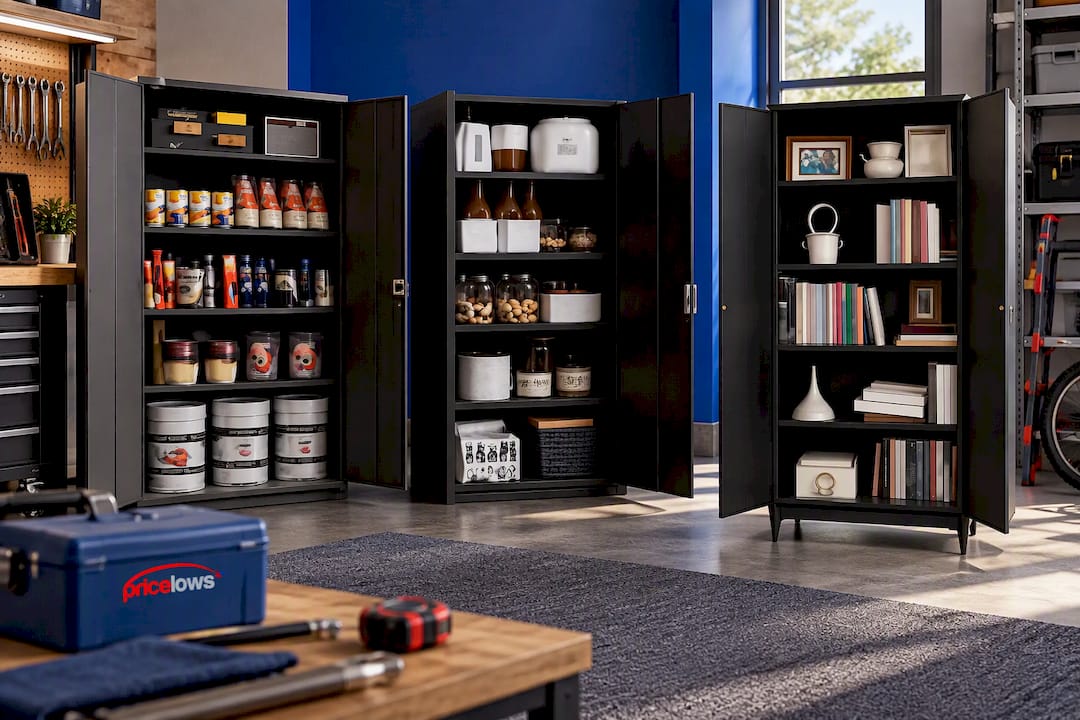
Start with the Black Locking Storage Cabinet With Shelves Heavy Duty if security is the priority, or the Black Metal Storage Cabinet With Lock And Shelves Garage for general organization. If you need shelf flexibility for irregular items, the Black Metal Storage Cabinet With Locking Adjustable Shelves covers that. Measure your space first, then pick your shipping option, and browse the full catalog at PriceLows™ for the rest of your home, yard, and garage list. For a step-by-step project to pair with your new cabinet, check the DIY garage shelving workflow guide.
Sources
FAQ
Who Is Menards’ Biggest Competitor?
Menards competes most directly with national big-box chains that offer similar lumber and hardware assortments, though its Midwestern footprint of roughly 355 stores across about 15 states means it doesn’t compete nationwide. Outside that region, shoppers naturally default to whichever national chain or online retailer serves their area.
Does Menards Support Donald Trump?
Menards’ founder has made political contributions and public statements over the years that have drawn media coverage, but the company itself doesn’t publish a formal political endorsement policy. If a retailer’s politics factor into your shopping decision, checking recent, dated news coverage directly is more reliable than relying on secondhand claims.
What Are Some Stores Similar To Menards?
Similar options fall into the categories covered above: national big-box chains for bulk materials, neighborhood hardware stores for small repairs, rural and outdoor specialists for ranch and yard needs, and online retailers like PriceLows™ for budget-priced storage, décor, and garage essentials. Which one fits depends on your project size and location.
What States Do Not Have Menards?
Menards operates in a contiguous block of roughly 15 Midwestern and Great Lakes states, per Specrom’s store data, meaning most of the South, the West Coast, and the Northeast have no Menards locations at all. Shoppers in those regions rely on national chains, local hardware stores, or online retailers by default rather than by choice.