


Ladder Safety: Match Types to OSHA Duty Ratings
Match the ladder to the job: stepladders for reach under 12 feet, extension ladders for outdoor height, platform ladders for extended work, and rolling ladders for warehouse shelving. The single rule that matters most is duty rating first, then material. Confirm the ladder’s labeled capacity covers you plus your tools, and choose nonconductive fiberglass rails anytime contact with live electrical equipment is possible. OSHA and ANSI set the baseline standards; many retailers carry vetted options built to those specs.
TL;DR:
- Most homeowners should choose a step ladder for indoor tasks under 12 feet and a fiberglass extension ladder for outdoor height work involving electrical risks.
- Always verify that the ladder’s duty rating covers your weight plus tools and materials, and select nonconductive fiberglass rails if contact with live electrical equipment is possible.
- Conduct a thorough inspection before every use, focusing on rungs, rails, hardware, and overall structural integrity, and replace any damaged ladder immediately.
- Proper setup, including a 4-to-1 angle and secure footing, is crucial; avoid overreaching or standing on the top rung to prevent falls.
- Use PPE like non-slip footwear, safety glasses, hard hats, and insulated gloves when working near electrical sources, and avoid outdoor work in wind or wet conditions.
Table of Contents
- What Are the Common Ladder Types and When Should You Use Each?
- How Do Duty Ratings and Ladder Materials Affect Safety?
- Choosing the Right Ladder and Inspecting It Before Every Use
- Setting Up and Using a Ladder Safely
- What Are the Key OSHA and ANSI Ladder Safety Regulations?
- Where Can You Get Real Ladder Safety Training?
- Which Personal Protective Equipment Matters Most on a Ladder?
- How Do You Reduce Fatigue and Strain During Ladder Work?
- How Should You Store and Maintain a Ladder for Long-Term Safety?
- What Should You Do If a Ladder Accident Happens?
- What Hazards Cause the Most Ladder Injuries?
- How Do Weather and Surface Conditions Affect Ladder Safety?
- What Homeowners Consistently Get Wrong About Ladder Safety
- Find a Ladder That Matches the Job, Not Just the Price Tag
- Sources
- FAQ
What Are the Common Ladder Types and When Should You Use Each?
Every ladder on the market falls into one of a handful of families, and picking the wrong one is the single biggest reason people either get hurt or just give up and call someone else. According to a fact sheet from Mississippi State University EHS, the safest ladder is always the one matched to the task, the environment, and the load, not the tallest or cheapest one in the garage.
Step ladders are the self-supporting A-frame design most homeowners already own. They don’t need a wall or any other surface to lean against, which makes them the default choice for changing light bulbs, painting interior walls, or reaching a top kitchen cabinet. Most run 4 to 12 feet, and the wider ones offer a small platform near the top for better footing.
Extension ladders are the two-section, non-self-supporting ladders you see against the side of a house for roof or gutter work. They extend well beyond 20 feet in some models and always need a wall, tree, or similarly solid surface to rest against at the correct angle.
Platform ladders look like beefed-up step ladders with a full standing platform and often a guardrail. They’re built for tasks that take more than a few minutes, like servicing HVAC equipment or working on ceiling fixtures, where standing on a narrow rung would wreck your legs.
Multi-purpose or articulated ladders hinge at multiple points so they convert between a step ladder, an extension ladder, a stairway ladder, and sometimes a scaffold base. They’re heavier and pricier than a basic step ladder but genuinely useful if you only have room to store one ladder and need it to do five jobs.
Rolling or warehouse ladders are the wheeled, self-supporting units you see in stockrooms and libraries. They’re designed for repeated short climbs to reach shelving, not for outdoor or uneven-surface work, and they lock in place once weight is applied.
Stepstools are the small, low-rise option, usually one or two steps, meant for tasks under 3 feet where a full ladder is overkill.
Fixed ladders are permanently mounted, typically on towers, silos, or building exteriors, and they fall under a separate set of OSHA rules covered later in this guide.
A quick note on specialty types: rope ladders and orchard/tripod ladders show up in niche uses like tree work or emergency egress, but they demand specific training and are not a substitute for a standard step or extension ladder in home or general work settings. If you’re not already trained on one, don’t improvise with it.
- Step ladder: best for indoor tasks under 12 feet with no wall nearby.
- Extension ladder: best for outdoor height work like roofs, gutters, and siding.
- Platform ladder: best for tasks lasting more than a few minutes at a fixed height.
- Multi-purpose ladder: best for varied jobs when storage space is limited.
- Rolling ladder: best for repeated shelving access in a warehouse or stockroom.
- Stepstool: best for quick, low-height reaches indoors.
- Fixed ladder: permanently installed, governed by separate OSHA device requirements.
How Do Duty Ratings and Ladder Materials Affect Safety?
A ladder’s duty rating is a tested weight limit, not a suggestion. Duty ratings run from Type III at 200 pounds up to Type IAA at 375 pounds, and the number has to cover your own body weight plus every tool, bucket, and material you’re carrying up with you, according to OSHA’s Portable Ladders Toolbox Talk.
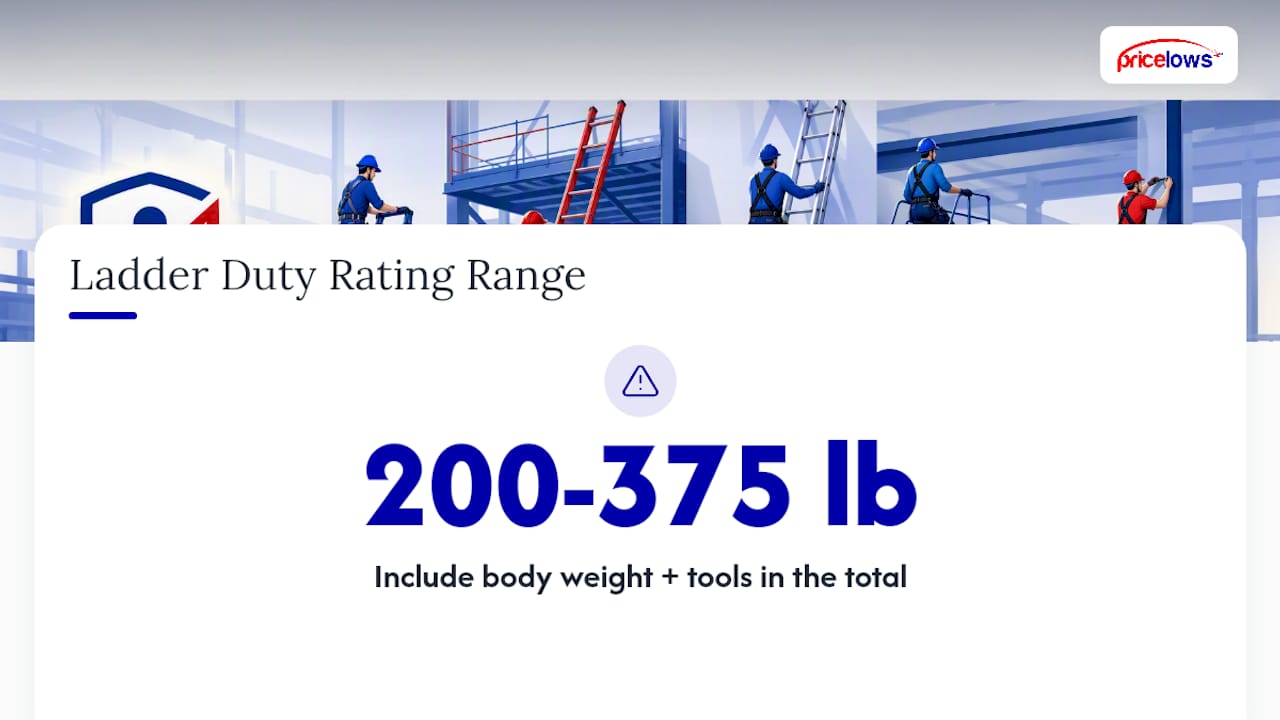
Pro Tip: Add up your body weight, your tool belt, and anything you’re hauling up before you shop. If that total sits close to a duty class’s limit, buy the next class up. It costs a little more and costs nothing when a rung has to hold you.
Duty rating is set by how the ladder is built and tested, not by what material it’s made from. A fiberglass ladder and an aluminum ladder can carry the exact same Type IA rating, so don’t assume one material automatically means more strength.
Material choice comes down to one hard rule: 29 CFR 1926.1053(b)(12) requires nonconductive side rails on any ladder used where the worker or the ladder itself could contact exposed energized electrical equipment, according to OSHA’s ladder standard. That trigger is broader than most people assume. It’s not limited to licensed electricians doing panel work. A painter working near a service drop or a roofer near a utility line needs fiberglass rails too.
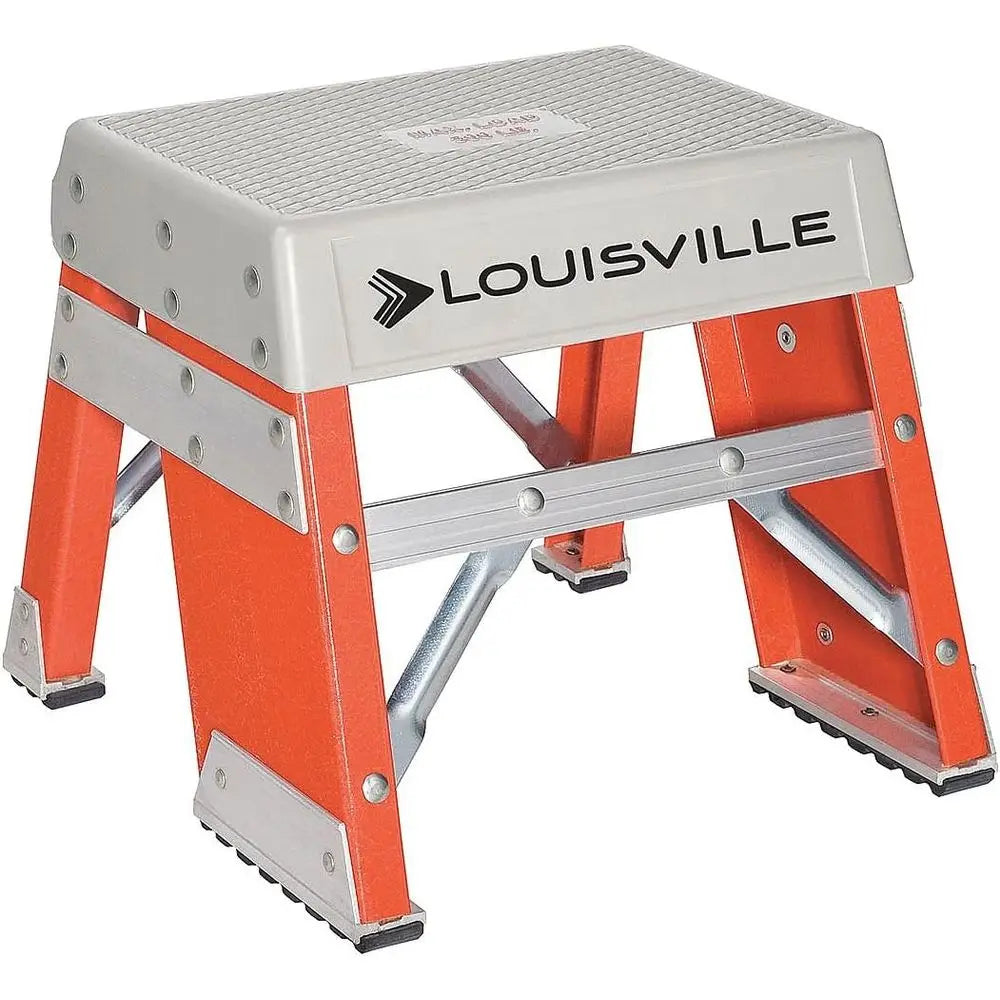
Fiberglass is nonconductive, resists UV and chemical exposure well, and holds up outdoors long term, but it’s heavier and pricier, typically running 30 to 40% heavier than an equivalent aluminum ladder according to a comparison from WC Safety. That dielectric protection only works when the rails are clean, dry, and undamaged. Fiberglass is never a substitute for de-energizing equipment before you work near it.
Aluminum is lighter, cheaper, and easier to carry up a ladder rack, but it conducts electricity, so it’s off the table for any job with electrical risk. It also dents more easily than fiberglass and can corrode near saltwater or harsh chemicals.
Wood ladders still show up in older commercial settings. They’re nonconductive when dry but degrade with moisture and UV exposure, and most professionals have moved away from them in favor of fiberglass.
Choosing the Right Ladder and Inspecting It Before Every Use
Getting the right ladder starts before you ever climb it. Walk through reach and height first: measure the work point, then remember that a ladder needs to extend at least 3 feet above the landing if you’re using it to access a roof or platform. Check the duty rating against your total working load, pick fiberglass if there’s any electrical exposure, and choose a platform ladder over a basic step ladder for anything lasting more than a few minutes. Stability matters as much as height. A ladder that wobbles on soft ground is a hazard no matter how well it’s rated.
Before every single use, run through the same inspection, every time, even if you used the ladder yesterday.
- Check the duty rating and instruction labels are still legible and attached.
- Inspect rungs and steps for cracks, bends, or looseness.
- Run your hand along both side rails checking for splits, corrosion, or fiberglass delamination.
- Test spreader bars and locking mechanisms to confirm they hold fully open.
- Check the feet for worn, missing, or hardened slip-resistant pads.
- Look over all hardware, bolts, and rivets for rust or missing pieces.
- Scan the whole ladder for any visible damage that wasn’t there before.
Any cracked rail, bent rung, or non-locking spreader means the ladder gets tagged and pulled from service immediately, not “used carefully one more time.” According to university EHS guidance, ladders need inspection before each use, and a competent person should inspect them periodically and after any event, like a drop or a storm, that could have affected safety.
To figure your total working load, add your body weight, clothing and PPE, tools on your belt, and any materials you’re hoisting. If that number puts you within 25 pounds of your duty rating’s limit, move up a class rather than pushing the ceiling.
Setting Up and Using a Ladder Safely
Most ladder falls trace back to bad setup, not bad luck. The 4-to-1 angle rule is the single fastest fix: for every 4 feet of height to the top support point, the base needs to sit 1 foot away from the wall. On a job site, that’s easy to eyeball by stepping back one foot for every four feet of ladder height, a method Virginia Tech EHS recommends as both regulation-backed and fast to apply without a protractor.
Extension ladders need to reach at least 3 feet above the landing point per OSHA’s stairways and ladders guidance, giving you something solid to grab when stepping onto the roof or platform. Secure the base with ties or stabilizers whenever the surface is uneven or the ladder will be left up for a while, and consider standoff accessories to keep the top away from gutters or siding that could crack under pressure.
Climbing technique matters more than most people think:
- Maintain three-point contact (two hands and a foot, or two feet and a hand) at all times.
- Always face the ladder, never climb sideways or backward.
- Keep both hands free; haul tools up with a bucket and rope or a tool belt, never in your hands.
- Keep your belt buckle between the side rails; if you’re reaching past that, climb down and move the ladder.
- Never stand on the top cap of a step ladder unless the manufacturer’s label explicitly allows it.
Pro Tip: If you catch yourself leaning to reach something “just a little farther,” that’s your body telling you to get down and reposition. Overreaching is the most common and most preventable ladder mistake there is.
The most common setup errors are predictable: propping a leg on a brick or paint can to level an uneven base, walking or “walking” the ladder sideways while standing on it, and setting up on wet grass or loose gravel without checking for give. Fix the base, not the workaround.
What Are the Key OSHA and ANSI Ladder Safety Regulations?
Portable and fixed ladders each carry their own measurable OSHA requirements, and knowing the numbers helps whether you’re running a job site or just want to buy with confidence.
- Fixed ladders above certain heights require safety devices, rest platforms, or lifelines per OSHA guidelines, per OSHA’s stairways and ladders guidance.
- Portable ladders used near energized equipment must have nonconductive side rails under 29 CFR 1926.1053(b)(12).
- Every ladder must carry legible duty rating and load labeling from the manufacturer.
- Two separate ladders may not be tied or fastened together to create additional length unless they’re specifically designed and listed for that use.
- Ladders require inspection before use and periodic inspection by a competent person on job sites.
- The 4-to-1 base-to-height angle and the 3-foot extension above the landing apply to portable ladder setup on every job.
These standards exist because setup and equipment failures, not one-off bad luck, cause the majority of ladder incidents. If you manage a crew or maintain equipment for a workplace, print these thresholds and check them against your own ladder fleet at least once a year. The full regulatory text and toolbox talk materials are linked in the sources section below.
Where Can You Get Real Ladder Safety Training?
Reading a guide like this one gets you most of the way there, but hands-on training closes the gap that no article can. Effective ladder safety training covers four things: how to select the right ladder for a task, how to run a pre-use inspection, correct setup and angle technique, and fall prevention, including when a competent person needs to step in and make the call.
The best programs combine a short video module with in-person, hands-on practice, not just a slideshow. A refresher every year or two keeps the habits sharp, and workplaces should keep training records on file in case of an OSHA inspection or an incident review.
For free, high-quality material, start with OSHA’s own Portable Ladders Toolbox Talk and the Stairways and Ladders publication (OSHA3124), both built for toolbox talks and printable checklists. University EHS departments, including Virginia Tech’s ladder safety page, publish similar checklists aimed at general staff, not just safety officers, which makes them a solid fit for homeowners too.
- Look for training that covers selection, inspection, setup, and fall prevention together, not in isolation.
- Prefer a hands-on or video-plus-practice format over a text-only module.
- Refresh training every 1 to 2 years, or after any ladder-related incident.
- Keep a simple record of who trained on what and when, even for a small crew.
Which Personal Protective Equipment Matters Most on a Ladder?
Ladder work doesn’t call for a full PPE kit, but skipping the basics is where a lot of avoidable injuries happen. Footwear comes first: closed-toe shoes with a solid, non-slip sole grip rungs and pedals far better than sandals or worn-out sneakers with smooth treads.
If you’re working overhead, especially under a structure, drywall, or old fixtures, safety glasses protect against falling debris and dust. A hard hat is worth wearing on any job site where other trades are working above or around you, even if your own task feels low-risk.
Gloves deserve a caveat: thin work gloves can improve rail grip in cold or wet conditions, but bulky or slick gloves actually reduce your grip and increase slip risk. Test your grip on the ground before you climb, not after you’re already ten feet up.
For anyone working near live electrical components, PPE goes beyond a nonconductive ladder. Insulated gloves rated for the voltage involved and, in higher-risk settings, arc-flash-rated clothing are standard practice, and they pair with, rather than replace, the fiberglass rail rule covered earlier.
A basic tool belt or bucket hoist counts as PPE in a practical sense too. Carrying tools by hand while climbing is one of the fastest ways to lose three-point contact, so keeping your hands free protects you as directly as any glove or hard hat does.
None of this gear is expensive or complicated. It’s also the equipment most likely to sit unused in a garage because “it’s just a quick job.” Those quick jobs are exactly where injuries happen.
How Do You Reduce Fatigue and Strain During Ladder Work?
Ladder fatigue sneaks up fast, and tired muscles are exactly what turn a minor wobble into a fall. Standing on a narrow rung for extended periods puts real strain on your calves, feet, and lower back, which is a big part of why platform ladders exist for longer jobs instead of a standard step ladder.
Take breaks before your legs start shaking, not after. Ten minutes on a rung feels different than ten minutes on solid ground, and most people underestimate how much that static position wears on their body compared to standing on the floor.
Position your body directly in front of your work rather than twisting or reaching to one side. Twisting while your feet stay planted on a rung puts uneven load through your spine and increases the odds of losing balance. If a task needs you to reach sideways more than an arm’s length, move the ladder instead of stretching.
Alternate tasks when possible. If you’re doing repetitive overhead work like painting a ceiling or installing fixtures across a room, break it into segments with time on the ground between climbs rather than one long stretch aloft. Your grip strength and balance both degrade with fatigue, and neither degrades in a way you notice in the moment.
Footwear and rung design matter here too. A wider-step platform ladder distributes weight better than a narrow-rung step ladder, and anti-slip rung padding reduces the constant micro-adjustments your feet make just to stay stable, which adds up over an hour of work.
How Should You Store and Maintain a Ladder for Long-Term Safety?
A ladder that’s been left in direct sun for two summers or leaned against a damp garage wall all winter is not the same ladder it was on day one. Proper storage protects both your investment and your safety margin.
Store ladders horizontally when possible, supported at multiple points along the rails, rather than leaning them vertically against a wall where they can warp or fall. If wall storage is your only option, use dedicated ladder hooks or a rack rather than propping it in a corner.
Keep ladders out of direct, prolonged sun exposure. UV breaks down fiberglass resin over time and can make aluminum surfaces brittle at stress points. A garage, shed, or covered area beats an open yard every time.
Wipe down rails after use in wet or muddy conditions, and dry fiberglass ladders fully before storage since moisture trapped against the surface accelerates degradation and undermines the nonconductive protection you’re relying on. Check hardware, rivets, and locking mechanisms seasonally, even if the ladder hasn’t seen heavy use, since corrosion doesn’t wait for a busy month.
Label duty rating and inspection dates somewhere visible if multiple people in a household or crew use the same ladder, so nobody grabs a ladder that’s overdue for a check. A little organization here pairs naturally with broader garage storage planning, since a ladder stored flat on a wall rack frees up floor space for everything else competing for room in a typical garage.
What Should You Do If a Ladder Accident Happens?
If someone falls or a ladder incident happens, the first move is assessing the person, not the ladder. Check for responsiveness, and if there’s any sign of head injury, spinal injury, or the person can’t move normally, don’t try to move them. Call emergency services immediately and keep them still until help arrives.
For less severe falls, still check for hidden injuries before assuming someone is fine. Sprains, hairline fractures, and concussions don’t always show obvious symptoms right away, and adrenaline can mask pain in the first few minutes after a fall.
Secure the area after the incident. Move the ladder out of the way if it’s safe to do so, and don’t let anyone else use it until it’s been inspected. A ladder involved in a fall may have hidden damage to rails, rungs, or locking hardware that isn’t visible without a close check.
If this happens at a workplace, document the incident: what task was being performed, the ladder’s duty rating and condition, and the setup conditions at the time. That record matters for OSHA reporting requirements and for figuring out whether the cause was equipment failure, setup error, or something environmental that needs fixing before the next job.
At home, treat any fall from a ladder over a few feet as worth a medical check, even if the person insists they’re fine. Some injuries, especially concussions and internal strain injuries, take hours to show symptoms.
What Hazards Cause the Most Ladder Injuries?
The riskiest moments on a ladder are rarely the dramatic ones. Overreaching, losing balance while carrying tools by hand, and setting up on an unstable or uneven surface account for the bulk of preventable incidents that safety professionals see repeatedly.
Tip-overs happen most often on extension ladders set up at too steep or too shallow an angle, which is exactly why the 4-to-1 rule gets repeated so often in this guide. A base that isn’t level, or feet resting on gravel, mud, or a sloped driveway, is a close second.
Falls from step ladders frequently trace back to someone standing on the top cap or the very top rung, both of which reduce stability dramatically and are labeled against on most consumer models for a reason. Reaching too far to one side while your feet stay planted is the other repeat offender, since it shifts your center of gravity outside the ladder’s stable base.
Electrical contact is a smaller share of incidents by count but disproportionately severe when it happens, which is exactly why the nonconductive rail rule under 29 CFR 1926.1053(b)(12) exists and why it applies to a wider set of jobs than most people assume.
Rushing is the common thread behind most of these. A ladder set up “close enough” to save two minutes, or a job finished from the top rung instead of climbing back down to reposition, is where the odds turn against you. None of this requires expensive gear to fix. It requires resisting the shortcut in the moment it’s tempting.
How Do Weather and Surface Conditions Affect Ladder Safety?
Wind, rain, and unstable ground change the math on every setup decision, and a ladder rated perfectly fine on a dry, level slab can become genuinely dangerous outdoors in the wrong conditions.
Wet or icy rungs and rails cut traction dramatically, and fiberglass in particular loses some of its electrical protection when contaminated with moisture, dirt, or grease. If rails are wet, dry them before climbing, and if a job can wait for better weather, let it wait.
Wind is an underrated hazard, especially for extension ladders set up outdoors near a roofline. Gusts can push a person off balance at height in a way that feels manageable on the ground but isn’t once you’re 15 feet upholding a tool. Skip outdoor extension ladder work on notably windy days.
Surface stability matters as much as weather. Gravel, mulch, soft soil, and sloped driveways all shift under a ladder’s feet in ways a flat concrete pad never will. Use a ladder leveler or stabilizing accessory on uneven ground rather than improvising with bricks or boards, which is one of the most common setup mistakes covered earlier in this guide.
Lighting rounds out the list and gets overlooked constantly. Working on a ladder in dim garage light or at dusk outdoors makes it harder to spot rung damage, judge distances, or notice a slipping foot before it becomes a fall. If you can’t see the base of the ladder and your feet clearly, add a work light before you climb rather than after something goes wrong.
What Homeowners Consistently Get Wrong About Ladder Safety
Most people treat ladder shopping the way they treat buying a phone charger: grab whatever’s cheapest and closest to the right size.
The data on duty ratings makes this obvious. A ladder isn’t rated for “a person.” It’s rated for a person plus everything they’re carrying, and most homeowners never do that math before they buy. Buy for your heaviest realistic job, tools and all, not for your body weight alone.
The electrical rule gets misunderstood the same way. People hear “electrical work” and picture a licensed electrician, not themselves painting a soffit near a service drop. If there’s any chance of contact with energized equipment, that’s a fiberglass-rail decision, full stop, regardless of your job title.
I’d also push back on one piece of conventional wisdom: that low upfront cost is the smart move on a ladder you’ll “only use a few times a year.” A ladder with a slightly higher duty rating and nonconductive rails costs more once and saves you from ever having to guess whether it’s rated for the job in front of you. Inspect it every time you pull it out, store it covered and out of direct sun, and treat the duty rating label as a hard limit, not a suggestion. A good ladder selection is built around exactly this logic: standards-aligned options rather than the cheapest thing that technically holds weight.
— Thane Holland
Find a Ladder That Matches the Job, Not Just the Price Tag
Some retailers selling ladders online focus on offering options picked to match a real duty rating and a real use case, not just a low price on the label. If your project involves any chance of contact with electrical equipment, the Fiberglass Step Ladder in 6-foot or 8-foot sizes gives you nonconductive rails and a slip-resistant platform, built for exactly the scenario OSHA’s electrical-contact rule covers.
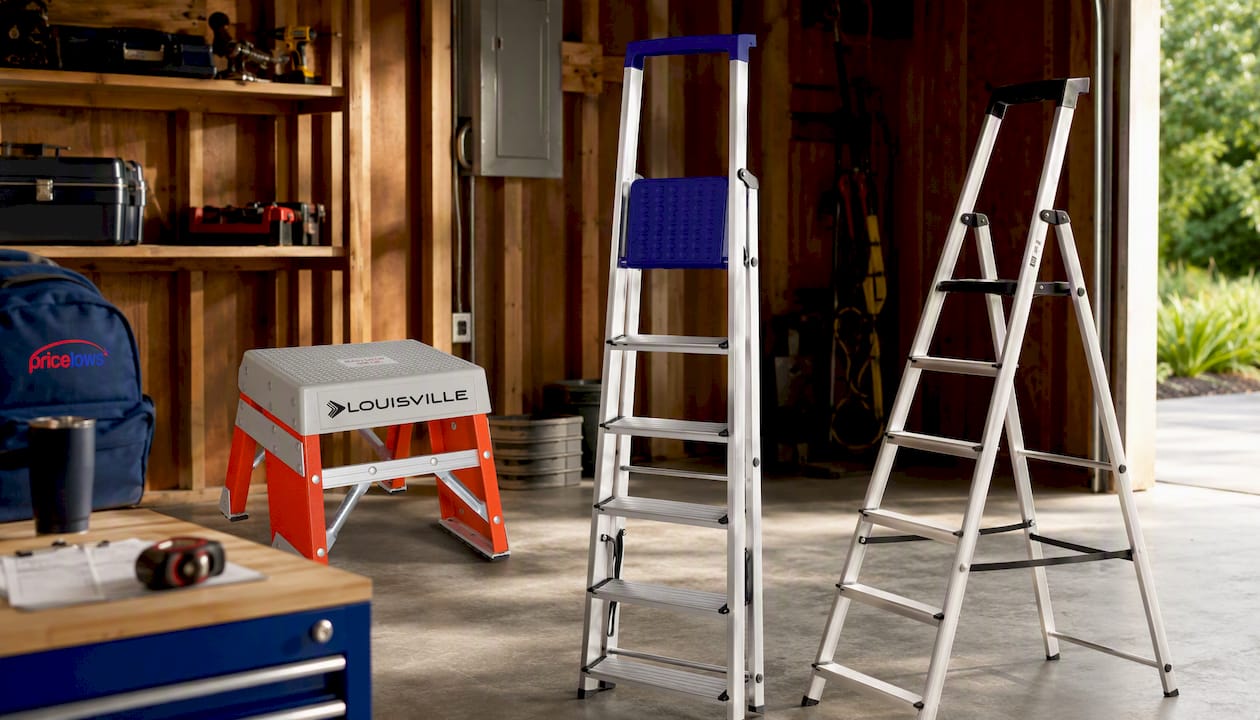
For everyday indoor tasks with no electrical risk, the Aluminum Folding Step Ladder rated for 330 pounds folds down small enough to store in a closet between jobs. If you split time between indoor projects and outdoor work like gutter checks or yard trimming, the Lightweight Aluminum 6 Step Ladder covers both with the same 330 pound capacity and anti-slip pedals.
Whichever you pick, check the duty rating label against your real working load before the first climb, and pair the purchase with a quick hands-on run-through of the setup rules covered in this guide. Browse the full home and garage lineup at PriceLows™, where every order ships free with 100% shipping protection included.
Sources
- OSHA standard 1926.1053 — ladders
- OSHA Stairways and Ladders (OSHA3124)
- Virginia Tech EHS — Ladder safety
FAQ
What Are the Three Main Types of Ladders According to OSHA?
OSHA’s guidance generally groups ladders into step ladders, extension (straight) ladders, and fixed ladders, each governed by its own setup and inspection rules. Portable ladders, which cover both step and extension designs, carry the duty rating and nonconductive-rail requirements detailed under OSHA’s 1926.1053 standard.
What Is the Safest Type of Ladder to Use?
There’s no single safest type; the safest ladder is whichever one matches the task, duty rating, and environment, according to MSU EHS. A platform ladder for longer indoor jobs and a fiberglass step ladder for anything near electrical risk both count as the “safe” choice for their specific use.
What Are the Four Main Types of Ladders?
Most guides group ladders into step, extension, platform, and multi-purpose/articulated as the four core consumer and commercial categories, with rolling ladders, fixed ladders, and step stools as additional common types. Each fits a distinct use case, from quick indoor reaches to warehouse shelving access.
What Are the Different Types of Safety Ladders?
Safety-focused ladder categories generally include duty rating (Type III through Type IAA) and material class (fiberglass, aluminum, wood), since both determine safe load and electrical exposure limits. Fiberglass ladders, like the options PriceLows™ carries, are the standard choice for electrical-risk tasks because of their nonconductive side rails.
How Much Weight Can a Ladder Actually Hold?
It depends on the duty rating printed on the ladder, ranging from 200 pounds for Type III up to 375 pounds for Type IAA, according to OSHA’s toolbox talk. That number has to cover your body weight plus tools and materials, not just your own weight alone.