


Gadget Ergonomics for Home Cooks: Reduce Strain & Cook Safer
TL;DR:
- Ergonomic kitchen tools and layout adjustments reduce muscular strain, safety risks, and improve task efficiency. Small, affordable changes like using support handles, adjusting tool grip size, and scheduling breaks can prevent injury and enhance comfort. Implementing proper ergonomic principles is essential for safer, more sustainable home cooking.
Ergonomic cooking gadgets measurably reduce muscular strain, cut safety risks, and speed up common kitchen tasks. That is not a comfort claim. StatPearls / NCBI defines ergonomics as aligning job requirements with the worker’s capability to minimize work-related musculoskeletal disorders (WMSDs) and fatigue. The role of gadget ergonomics in cooking is straightforward: the right tool, sized and shaped correctly, keeps your wrists neutral, your grip relaxed, and your back out of trouble. PriceLows™ carries a range of affordable options that put these principles within reach for any home cook.
Three quick wins you can act on today:
- Low-cost gadget: Swap a thin-handled peeler for one with a soft, compressible grip (handles with a compressible grip diameter near the recommended ergonomic range).
- Posture tip: Set a timer for 30–45 minutes and take a short break. Practitioners recommend this as one of the highest-impact, lowest-cost interventions for hand and wrist strain.
- Layout tweak: Move your five most-used tools into a single reach zone so you stop twisting and stretching across the counter.
Table of Contents
- What does kitchen ergonomics actually mean?
- Common ergonomic problems cooks face at home
- Core ergonomic principles for gadgets and kitchen layout
- Ergonomic gadget categories that make cooking easier
- How to choose ergonomic cooking gadgets: what to look for
- Simple steps to make your home kitchen more ergonomic
- What research says about measurable ergonomic benefits
- Cost and what to buy first for the best return on comfort
- Key Takeaways
- Why ergonomics in the kitchen deserves more credit than it gets
- Affordable ergonomic kitchen gadgets at PriceLows™
- Useful sources and further reading
What does kitchen ergonomics actually mean?
Ergonomics in cooking means designing the relationship between you, your tools, and your workspace so that physical effort stays within safe limits. The goal is not just feeling comfortable. Kitchen ergonomics research groups the field into four themes: layout and arrangement, tools and technology, design for special needs, and risks and hazards. Each theme targets a measurable outcome: fewer aches, lower error rates, faster task completion.
The core components to evaluate are anthropometrics (does the tool fit your hand size?), posture (does the task keep your wrist and spine neutral?), force (how hard do you have to grip or push?), repetition (how many identical motions does the task require?), control interface design (where are the buttons and handles placed?), and environmental factors like floor surface and lighting. Comfort is the subjective sensation you feel when all of these are right. Ergonomists target the measurable inputs, not the feeling itself.
One underappreciated point: ergonomics research shows that tools are often sized to average male dimensions, which increases WMSD risk for women and smaller-stature users. Choosing adjustable or size-varied tools is not a preference issue. For many cooks, it is a safety one.
Common ergonomic problems cooks face at home
Most kitchen strain builds up quietly. You do not throw your back out lifting a pot once. You accumulate damage over hundreds of sessions of awkward reaching, tight gripping, and standing on hard floors.
The most frequent culprits:
- Repetitive wrist and hand motions. Chopping, whisking, and grating involve the same small muscles firing over and over. Forceful grips, like twisting a stuck jar lid, add acute load on top of that cumulative fatigue.
- Awkward reach and poor counter height. Reaching across a wide counter or working at a surface that is too low forces your shoulders up and your neck forward. Over a 45-minute prep session, that posture adds up fast.
- Prolonged standing on hard floors. Static posture on tile or hardwood is one of the most common sources of lower-back and foot fatigue in home kitchens.
- Lifting heavy cookware without support. A full cast-iron skillet or a stockpot of water is heavy enough to strain the wrist and elbow, especially when lifted one-handed from a low cabinet.
- Heat and slip risks from unstable tools. Reaching over a burner with a wobbly cutting board or a pot without a helper handle creates both burn and spill hazards.
Pro Tip: Minor aches after cooking are an early warning, not normal wear and tear. Practitioners advise addressing them immediately with small changes rather than waiting for a chronic injury to develop.
Core ergonomic principles for gadgets and kitchen layout
Five principles cover most of what you need to evaluate any tool or arrangement:
- Fit the person. Handle diameter matters more than most cooks realize. Ergonomics literature recommends grip diameters near 50–75 mm with a smooth, compressible surface to maximize grip strength and minimize required force. A thin metal handle forces a tighter, more fatiguing grip.
- Reduce force. Mechanical advantage is your friend. Rocker knives, lever-style jar openers, and food processors all replace muscular effort with geometry or motor power.
- Promote neutral posture. Wrists should stay flat, not bent up or down. Necks should stay level. Counter height, cutting board thickness, and the angle of appliance control panels all affect this.
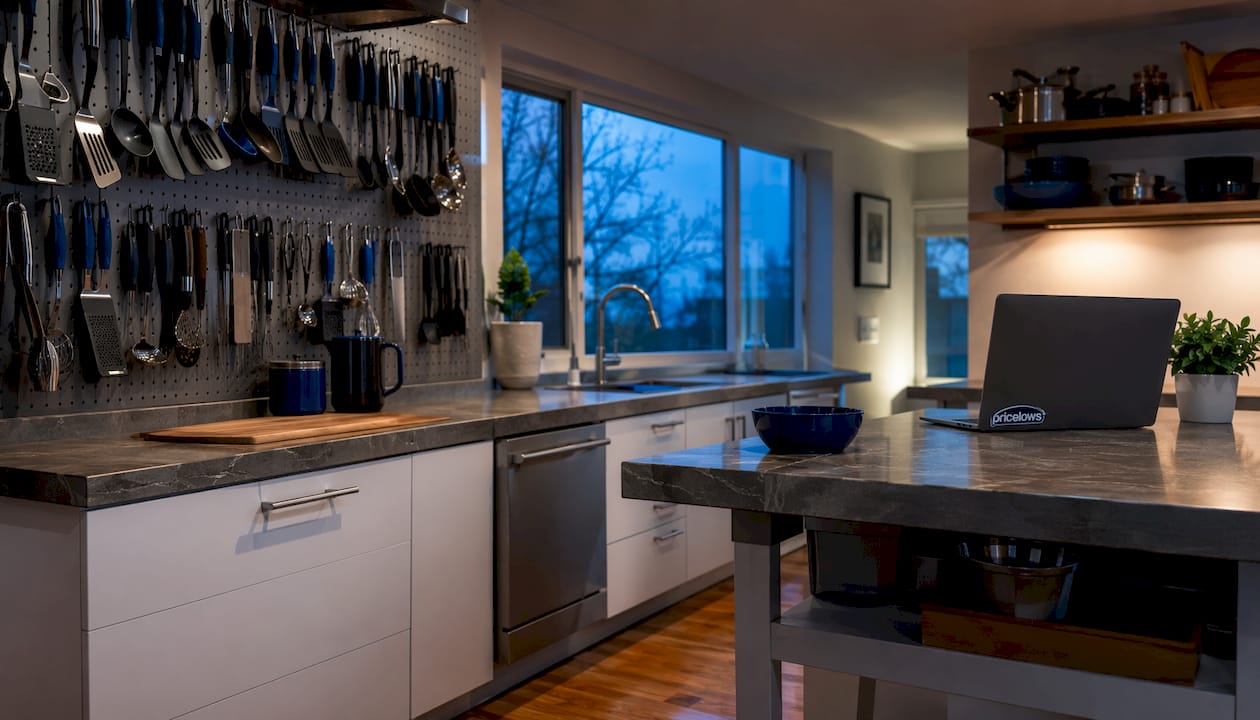
- Minimize repetition and awkward reach. Cluster your most-used tools within a comfortable arm’s reach. Work zones, where prep, cooking, and plating each have a dedicated spot, cut the number of steps and reaches per meal.
- Prefer adjustability and stability. Non-slip bases, helper handles on heavy pots, and adjustable stools for seated prep all reduce the chance of a sudden load or slip.
Pro Tip: For appliance placement, research on control-panel angles suggests 15–19° is often the sweet spot for combining visibility and comfort. Tilting a countertop appliance slightly toward you reduces neck flexion during use.
Ergonomic gadget categories that make cooking easier
The Arthritis Foundation and accessibility researchers have documented specific tool categories that reduce force requirements and wrist strain. Here is how each maps to a real cooking problem:
- Adaptive cutting boards. Boards with suction-cup feet, raised edges, and spike inserts hold food steady without a second hand. They eliminate the grip-and-brace motion that strains the non-dominant wrist.
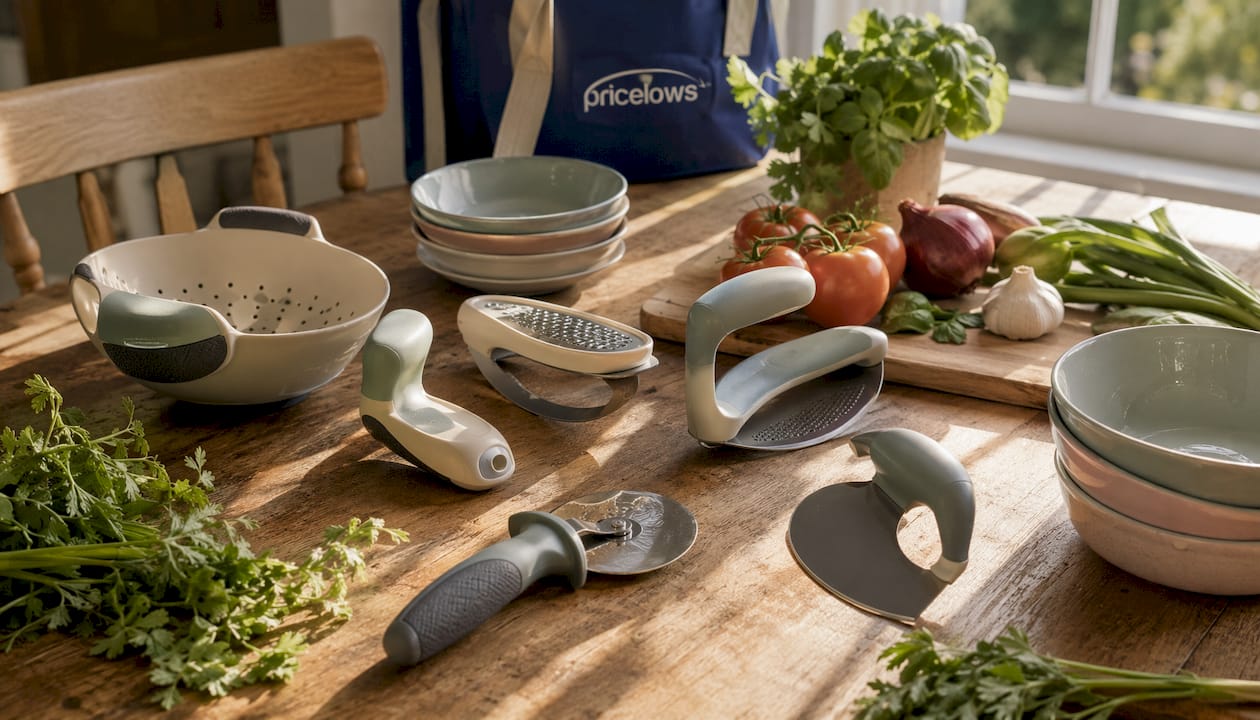
- Rocker knives. The curved blade lets you rock through a cut rather than pushing straight down. Less force per stroke, and the wrist stays closer to neutral throughout.
- Soft-grip and large-handle utensils. Spatulas, peelers, and whisks with thick, compressible handles reduce the grip force needed and distribute pressure across more of the palm.
- Jar and bottle openers. Lever-style or electric openers remove the forceful twisting motion that is one of the most common triggers for wrist and forearm strain, especially for people with arthritis.
- Helper-handle cookware. A second handle on a heavy saucepan or skillet lets you distribute the load across both hands and arms. That single change can cut the effective strain of lifting by roughly half.
- Non-slip mats and cutting board liners. Stability under a cutting board or mixing bowl means you stop using one hand to hold things still and can focus both hands on the task.
- Food processors and electric multi-cookers. For repetitive chopping, slicing, or long-simmer stirring, powered tools replace dozens or hundreds of identical hand motions. Adaptive kitchen tools like these reduce the need for forceful grips and complex wrist movements.
- Anti-fatigue mats. A cushioned mat under your feet during prep reduces lower-back and leg fatigue during long standing sessions. The effect is immediate and the cost is low.
- Timers. The most underrated ergonomic tool in any kitchen. Using a timer to schedule short breaks every 30–45 minutes reduces cumulative strain as effectively as many hardware changes.
- Reach-assist tools and long-handled utensils. Extended handles on ladles, tongs, and spatulas keep your arm and shoulder in a safer position when reaching over a hot burner or into a deep pot.
For cooks with limited hand strength, the Arthritis Foundation specifically recommends adaptive cutting boards with stabilizing spikes, rocker knives, and lever-style openers as tools that maintain independence in the kitchen. These are not specialty items. Most are available through mainstream retailers and must-have kitchen gadgets guides.
How to choose ergonomic cooking gadgets: what to look for
A quick framework for evaluating any tool before you buy it:
Evaluation criteria:
- Grip fit. Can you hold it comfortably without squeezing hard? The handle should fill your palm, not disappear in it.
- Weight. How heavy is it when full or in use? A light empty pot can become a strain risk when loaded.
- Non-slip surface. Does the base stay put? Does the handle resist slipping when wet?
- Adjustability. Can both left- and right-handed cooks use it comfortably?
- Cleaning ease. A tool you avoid washing is a tool you stop using.
- Control layout for powered gadgets. Are buttons large enough to press without awkward finger positioning? Is the panel angled toward you?
Questions to ask while shopping:
- Can I use this with either hand?
- Is the grip compressible, or is it hard plastic or thin metal?
- How heavy is it when full?
- Does it have a non-slip base or feet?
- Can I operate the controls without bending my wrist or craning my neck?
Red flags to avoid: excessively thin or hard handles, top-heavy designs that tip when set down, fixed single-angle controls that force neck flexion, and small buttons with no tactile feedback. When possible, pick up the tool in the store and simulate the task for 10–30 seconds. Grip fatigue shows up faster than you expect.
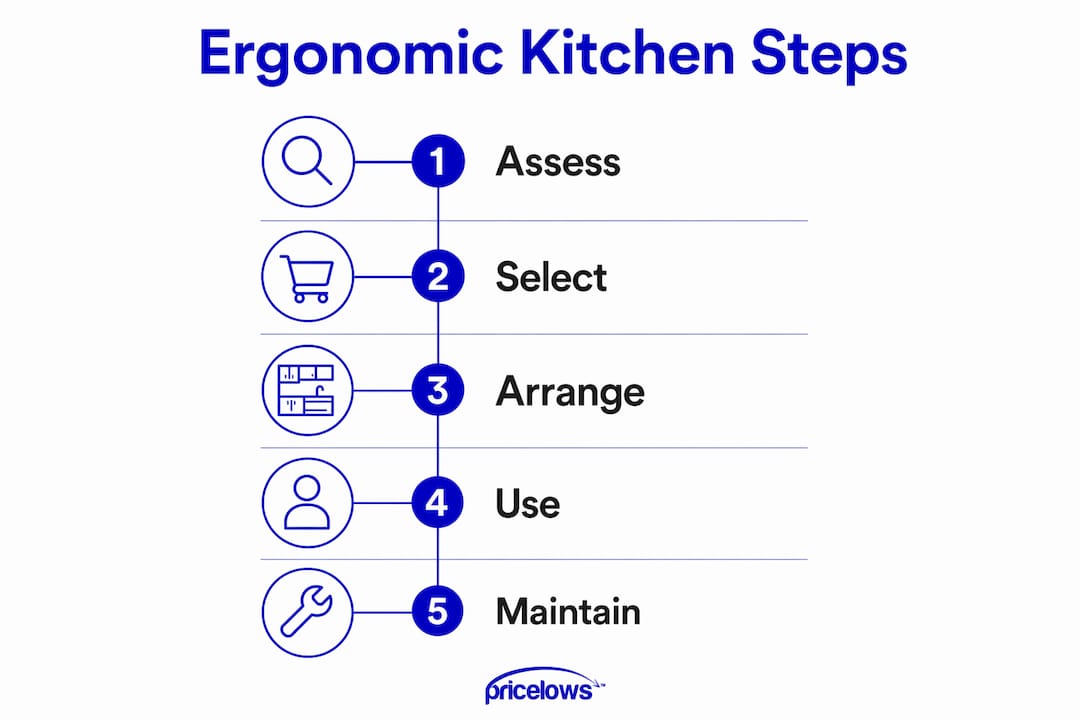
Simple steps to make your home kitchen more ergonomic
Start cheap and high-impact, then layer in medium-cost upgrades as budget allows.
- Place an anti-fatigue mat at your main prep station. This is the single fastest way to reduce lower-back and leg fatigue during long cooking sessions. Cost is low; impact is immediate.
- Set a timer for breaks. Every 30–45 minutes, step away for a few minutes and shake out your hands. This behavioral change costs nothing and directly reduces cumulative wrist and shoulder strain.
- Rearrange your reach zone. Identify the five tools you use every session and move them to a spot you can reach without twisting or stretching. Everything else can live in a cabinet.
- Add a helper handle to your heaviest cookware. Many pots and pans accept clip-on helper handles. If yours do not, consider a removable handle cookware set that solves the problem at the source.
- Buy one adaptive cutting tool. A rocker knife or a suction-base cutting board replaces the most repetitive and force-intensive prep task in most kitchens.
- Install under-cabinet lighting. Poor lighting makes you lean in and crane your neck. A simple LED strip under the upper cabinets keeps your head level and your neck neutral.
- Use a non-slip shelf liner under mixing bowls and cutting boards. Costs almost nothing. Eliminates the stabilizing grip that quietly fatigues your non-dominant hand.
If you experience persistent pain or symptoms that do not resolve within a few days of making these changes, consult an occupational therapist. Chronic WMSD symptoms need professional assessment, not just better gadgets.
Pro Tip: Keep non-slip bases clean and dry. Grease or food residue on a suction-cup foot or rubberized base reduces its grip significantly, which defeats the ergonomic purpose of the tool.
What research says about measurable ergonomic benefits
The evidence behind kitchen ergonomics is not anecdotal. StatPearls / NCBI documents that proper ergonomics implementation reduces WMSDs across multiple work settings, cutting lost workdays and associated health costs. The same source confirms that occupations requiring repetitive actions, heavy lifting, or prolonged awkward positioning carry the highest WMSD risk. Home cooking checks all three boxes during a typical meal prep session.
For appliance and control-panel placement, research on touchscreen and control-panel angles identifies 15–42° as the range that gives most users adequate visibility, with 15–19° often the optimal balance of comfort and readability. Placing a countertop appliance at a slight tilt toward you, rather than flat on the counter, reduces the neck flexion that accumulates over repeated use.
Ergonomic product design that changes hand posture, such as tools with angled or offset handles, can reduce hand movement and muscular strain. The Logitech ergonomics whitepaper notes that ergonomic input devices sometimes advertise measurable movement reductions as a design metric. The same principle applies to kitchen tools: a rocker knife that keeps the wrist neutral through a cut is doing the same mechanical work as an ergonomic mouse that keeps the forearm neutral through a scroll.
| Evidence Area | Finding | Source |
|---|---|---|
| WMSD reduction | Ergonomics implementation reduces WMSDs, lost workdays, and fatigue across work settings | StatPearls / NCBI |
| Control-panel angle | 15–19° panel tilt often optimal for comfort and visibility; 15–42° gives broad usability | Applied Sciences study |
| Adaptive tools | Rocker knives, adaptive boards, and lever openers reduce forceful grip and complex wrist motion | Arthritis Foundation |
| Break scheduling | 15-minute breaks every 30–45 minutes reduce hand, wrist, and shoulder strain | PCWorld ergonomics column |
Cost and what to buy first for the best return on comfort
Not every ergonomic upgrade costs much. The highest-impact changes are often the cheapest.
Low-cost, high-impact (under $20–$30 for most items):
- Anti-fatigue mat for your main prep station
- Kitchen timer (or a phone timer app)
- Non-slip shelf liner cut to fit under cutting boards and bowls
- One adaptive cutting tool: a rocker knife or a suction-base board
Mid-range investments ($30–$100):
- Helper-handle or detachable-handle cookware that distributes the weight of heavy pots
- Electric food processor or multi-cooker to replace repetitive chopping and stirring
- Adjustable stool or chair for seated prep tasks
The ROI on these purchases is not abstract. Fewer aches mean fewer interruptions mid-session. Better tool stability means fewer spills and burns. And catching strain early, before it becomes a chronic WMSD, avoids the far larger cost of physical therapy or lost cooking time. For budget-conscious shoppers, the best budget kitchen gadgets guide at PriceLows™ covers ergonomics-forward picks without the premium price tags.
Durability matters in the ROI calculation too. A cheap non-slip base that peels off after three months is not a bargain. Look for silicone or rubberized bases on cutting boards and mixing bowls, and check that soft-grip handles are bonded, not just sleeved over a hard core.
Key Takeaways
Ergonomic gadgets and simple layout changes deliver measurable strain reduction, fewer safety incidents, and faster task completion for home cooks at every skill level.
| Point | Details |
|---|---|
| Grip diameter matters | Handles near 50–75 mm with compressible surfaces maximize grip strength and minimize required force. |
| Breaks are a tool | Scheduling 15-minute breaks every 30–45 minutes reduces cumulative wrist and shoulder strain as effectively as hardware changes. |
| Start cheap | An anti-fatigue mat, a timer, and a non-slip liner deliver immediate, measurable comfort gains at low cost. |
| Control-panel angle | Tilting appliances to 15–19° reduces neck flexion during repeated use, per applied ergonomics research. |
| PriceLows™ for affordable options | PriceLows™ carries detachable-handle cookware, kitchen storage, and budget gadgets that align with these ergonomic principles. |
Why ergonomics in the kitchen deserves more credit than it gets
Most ergonomics advice focuses on office chairs and monitor heights. The kitchen gets almost no attention, which is strange when you consider that a serious home cook spends as many hours at a cutting board as a desk worker spends at a keyboard, often with far more force and repetition involved.
The conventional wisdom is that kitchen strain is just part of cooking. You chop a lot, your wrist gets tired, that is the deal. That framing is wrong, and the research backs the correction. WMSDs do not develop because cooking is inherently hard on the body. They develop because the tools and layout have not been matched to the person using them. A cutting board that slides, a pot with one thin handle, a peeler with a pencil-thin grip: these are design failures, not cooking realities.
What people underestimate is how much the low-cost fixes matter. The anti-fatigue mat and the timer are not consolation prizes for cooks who cannot afford a kitchen renovation. They are, according to the evidence, among the highest-impact interventions available. The expensive stuff, adjustable counters, custom cabinetry, premium adaptive tools, adds value at the margins. The cheap stuff addresses the root causes directly.
There is also a fairness dimension worth naming. Ergonomics tools are often sized to average male dimensions, which means women and smaller-stature cooks are working with equipment that was never designed for them. Choosing tools with adjustable grips or size-varied handles is not a niche concern. For a large share of home cooks, it is the difference between a tool that works and one that quietly causes harm.
Affordable ergonomic kitchen gadgets at PriceLows™
Knowing what to buy is only half the problem. Finding it at a price that makes sense for a family budget is the other half.

PriceLows™ stocks kitchen storage, cookware with detachable handles, and home organization tools that directly support the ergonomic principles covered here. The kitchen storage and utensil rack keeps your most-used tools within reach and off cluttered counters, which is one of the simplest layout changes you can make. For cooks who want to tackle heavier storage, the Rolling Garage Tool Cabinet offers lockable, rollable storage that keeps bulky items accessible without awkward bending or lifting from low shelves. Every order ships free with PriceLows™'s 100% shipping protection plan. Browse the full range at PriceLows™ and start with the one change that fits your kitchen and your budget today.
Useful sources and further reading
Use the clinical and peer-reviewed sources for understanding injury risk and ergonomic principles. Use the product guides for shopping decisions.
- Ergonomics — StatPearls / NCBI Bookshelf: The foundational clinical reference for WMSD risk, ergonomic principles, and grip-diameter recommendations. Start here for the science.
- Arthritis Foundation — Arthritis-Friendly Kitchen Tools: Practical guidance on adaptive cutting boards, rocker knives, and lever openers for cooks with limited hand strength.
- Kitchen Ergonomics in Health and Healthcare: Rapid Scoping Review: Groups kitchen ergonomics research into layout, tools, special-needs design, and hazards. Useful for understanding the full scope of the field.
- Applied Sciences Study on Control-Panel Angles: The source for the 15–42° and 15–19° panel-angle recommendations cited in this article.
- IJIE Article on Appliance Control Design: Covers how control-panel angle and knob placement affect neck and back strain during kitchen tasks.
- PCWorld Column on Practical Ergonomics: Accessible overview of behavioral interventions (timers, breaks, task rotation) and their impact on cumulative strain.
- PriceLows™ Blog — Ergonomic Yard Tools and Strain Reduction: Shows how the same ergonomic principles applied in the kitchen extend to yard and outdoor tools.
- PriceLows™ Blog — Upgrade Kitchen Tools Without Overspending: Budget-first guidance for replacing high-strain tools with ergonomics-forward alternatives.
This article is general information, not medical or occupational health advice. For persistent pain or chronic symptoms, consult a qualified occupational therapist or healthcare professional.