


5 Questions to Pick the Right Mop: Steam or Spin, PriceLows™ Picks
If your home is mostly sealed tile and you want real sanitizing power, a steam mop wins. If you have mixed flooring, laminate, unsealed wood, or you’re watching your budget, a spin mop is the safer, cheaper call. The tiebreaker is your floor type first and how often you clean second; read on for the floor-by-floor breakdown and the maintenance costs that don’t show up on the price tag.
TL;DR:
- Spin mops are more suitable for mixed flooring and handling heavy, wet spills, especially in homes with unsealed wood or laminate floors.
- Steam mops are safe only on sealed tile and grout, with some models also acceptable for sealed hardwood if manufacturer guidelines are followed.
- The initial cost for steam mops is higher, and they require regular descaling and specific floor type compatibility checks.
- Spin mops cost less upfront, but require ongoing replacement of microfiber heads and manual effort to wring out excess water.
- Using both tools strategically—spin mop for daily cleaning and steam mop for deep sanitizing—offers the best balance of cost, safety, and effectiveness.
Table of Contents
- How Steam Mops and Spin Mops Actually Work
- Steam Mop vs Spin Mop: Weighing the Trade-Offs
- What Floors Should You Not Use a Steam Mop On?
- What Does Each Mop Cost Over Time?
- How Do You Choose the Right Mop for Your Home?
- Which PriceLows™ Spin Mop Fits Your Household?
- Why You Can Trust This Comparison
- A Practical Take: Why the Hybrid Approach Wins
- Where to Find the Right Spin Mop at PriceLows™
- Sources
- FAQ
How Steam Mops and Spin Mops Actually Work
A steam mop heats water in a small tank and pushes it out as hot vapor through a microfiber pad. That heat breaks down grease and grime without you adding a single drop of cleaning solution, and the tiny water volume means it dries fast. Steam is also doing double duty. It’s not just lifting dirt, it’s sanitizing the surface as it goes, which is why it shows up so often in kitchen and bathroom cleaning routines.
A spin mop works on a completely different principle: you, not heat, control the process. You dunk a microfiber head in a bucket, spin it in a built-in wringer to squeeze out excess water, and mop with whatever wetness level you choose. Want it nearly dry for hardwood? Spin it hard. Need it saturated for a sticky spill? Leave it damp. You can also add your own cleaning solution to the bucket, something a steam mop’s plain-water system doesn’t allow.
The two tools are simply built for different jobs:
- Steam mops excel at loosening dried, baked-on grime, like old grease near a stove, and drying quickly afterward.
- Spin mops handle heavier, wetter messes better because you control both the water volume and the cleaning agent.
- Steam sanitizes through heat alone; spin mopping relies on whatever solution you put in the bucket.
- Neither tool replaces a vacuum first. Loose debris and pet hair should come up before either mop touches the floor, which is worth remembering if you’re weighing a shop vac against a regular vacuum for pre-mop cleanup.
Independent testing backs this split: wet mops and spin mops handle heavier spills better, while steam mops are the stronger tool for dried grime and fast drying time. Neither tool is universally “better.” They’re built for different messes.
Steam Mop vs Spin Mop: Weighing the Trade-Offs
Every steam mop advantage comes with a corresponding limitation, and the same is true in reverse for spin mops. Knowing both sides before you buy saves you from a returns process later.
Steam mop pros:
- Sanitizes without chemicals, which matters if you have crawling babies or pets that lick the floor.
- Dries fast, since it uses so little water.
- No bucket to fill, dump, or scrub afterward.
Steam mop cons:
- Restricted to certain floor types (more on that below).
- Needs an outlet and a minute or two to heat up before every use.
- Higher upfront cost than a basic spin mop.
Spin mop pros:
- Low cost of entry.
- Safe across most hard flooring when wrung properly.
- No cord, no heat, no waiting.
Spin mop cons:
- More physical effort. You’re filling buckets, wringing heads, and dumping dirty water yourself.
- Water can recirculate grime if you don’t change it often enough, especially in a large home.
- Longer drying time than steam, since more water hits the floor.
Think about how these play out in real scenarios. A dog accident on tile calls for a spin mop loaded with an enzyme cleaner, not a steam mop that would just spread the mess with plain water. Weekly bathroom tile sanitizing is the opposite case: steam wins because you want heat, not chemical residue, on a surface people walk on barefoot. Kitchen grease near the stove often needs steam’s heat to break it down, while a wine spill on the dining room floor is a job for a spin mop and a damp head.
Pro Tip: For pet accidents on any floor, treat the spot with a dedicated enzyme-based stain and odor remover before you mop. Neither steam nor spin mopping alone fully neutralizes pet odor at the source.
What Floors Should You Not Use a Steam Mop On?
This is the question that decides most purchases, so here’s the direct answer: steam mops are safest on sealed tile and grout, and risky on almost everything else.
- Tile and grout: Steam is effective on sealed tile and grout and can lift grime out of grout lines that a spin mop’s flat head can’t reach.
- Sealed hardwood: Conditional. Only use steam if the manufacturer explicitly allows it and your mop has a low-moisture or hardwood setting. When in doubt, use a well-wrung spin mop instead.
- Laminate and luxury vinyl plank (LVP): Avoid steam. Uncontrolled steam exposure can cause these floors to swell or their seams to lift, and most manufacturers warn against it directly.
- Unsealed wood and porous stone (like unsealed marble or slate): Avoid steam entirely. Moisture and heat can penetrate the surface and cause staining or warping.
If your home mixes tile with laminate or hardwood, which describes a huge share of American homes, the safest strategy is picking the tool that works for your most sensitive floor rather than your toughest one. A steam mop that’s perfect for your bathroom tile can quietly damage your living room laminate in a matter of months. Home publishers consistently recommend checking your flooring manufacturer’s warranty language before steam touches anything but tile. Many households end up keeping both tools on hand for exactly this reason: a spin mop for daily coverage across every room, and a steam mop reserved for the tile and grout that can handle it.
What Does Each Mop Cost Over Time?
The sticker price only tells part of the story. Spin mops typically run $20 to $60, while consumer steam mops start around $50 and can climb past $200 for models with larger tanks or multiple attachments. That gap widens once you factor in what each tool needs to keep working.
- Spin mop upkeep: Replacement microfiber heads run a few dollars each, and most manufacturers recommend machine-washing the heads and rinsing and air-drying the bucket after every use to prevent mildew and lingering odor.
- Steam mop upkeep: Tanks need periodic descaling to clear mineral buildup from tap water, and pads wear out with heat exposure, adding a small but steady recurring cost.
- Durability: Spin mops have fewer moving parts to break. Steam mops have heating elements and pumps that can fail earlier, so check the warranty length before buying.
If a bucket sits wet and sealed after use, mildew shows up fast. Air-drying the bucket upside down and emptying the steam tank between uses solves most of that problem for both tools. For more ways to trim your overall cleaning costs, PriceLows™ has a budget-focused cleaning guide worth a look, and a rundown of multipurpose cleaners that pair well with a spin mop’s flexible water-and-solution setup.
How Do You Choose the Right Mop for Your Home?
Work through these questions in order, and the answer usually becomes obvious by the third one.
- What’s your dominant floor type? Mostly sealed tile and grout points to steam. Any mix of laminate, LVP, or unsealed wood points to spin.
- How big is your home? Larger homes favor spin mops with a bigger bucket capacity and a telescoping handle, since you’ll cover more square footage per fill.
- Do you have kids or pets? Chemical-free sanitizing pushes you toward steam on floors where it’s safe; frequent spills and accidents push you toward a spin mop you can load with an enzyme cleaner.
- How much storage do you have? Spin mop buckets take up more floor space; steam mops are usually more compact and often store upright.
- What’s your budget, including upkeep? Factor in replacement heads or pads, not just the sticker price.
If you land on steam, look for adjustable steam settings, a large enough tank that you’re not refilling constantly, quick heat-up time, and a dedicated low-moisture or hard-floor mode. If you land on spin, prioritize a sturdy wringer mechanism that won’t loosen after a few months, at least two extra washable heads, a telescoping handle for tall closets and low shelves, and a splash-resistant bucket design.
Pro Tip: If you can’t decide, buy the spin mop first. It costs less, works across nearly every floor type in your home, and you can always add a steam mop later once you know exactly which rooms need it.
Which PriceLows™ Spin Mop Fits Your Household?
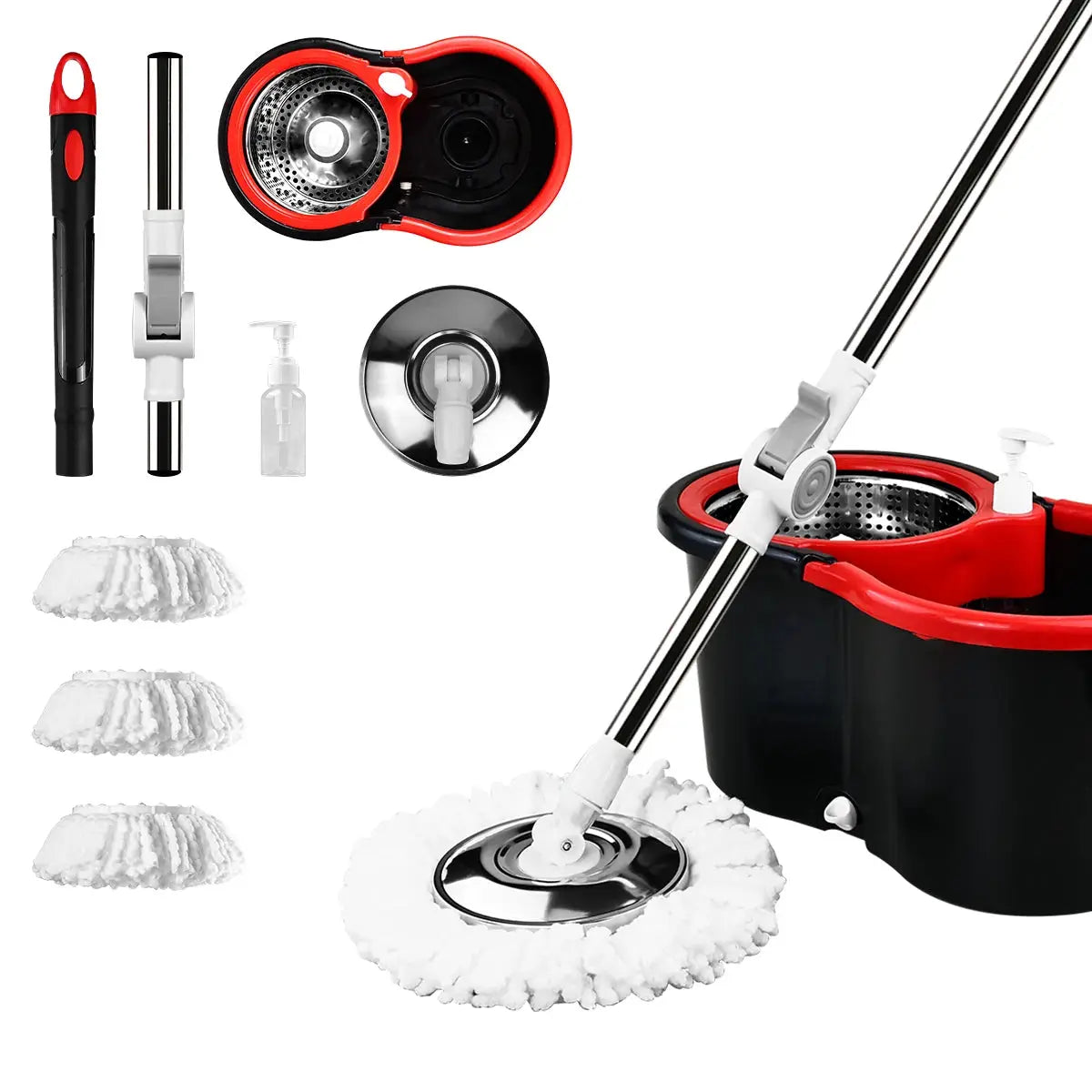
Once you’ve settled on spin over steam, or decided to keep spin as your everyday tool, the next question is which setup actually matches your home. PriceLows™ carries three spin mop systems built around the same core idea: a 360 degree rotating head and a wringer bucket that does the hard work for you.
- The 360 Dual-Motion Spin Mop System comes with three split-yarn mop heads and a self-cleaning bucket, a solid fit for a family home with mixed flooring and daily foot traffic.
- The 360 Rotating Head Spin Mop Bucket ships with two microfiber heads and a compact, one-size design, better suited to an apartment or smaller space where storage room is tight.
- The 360 Spin System Bucket Set with Long Handle includes three microfiber replacement heads and an extended handle, built for larger homes or heavier, more frequent use.
Across all three, plan on replacing a mop head roughly as often as you’d replace a steam mop pad, generally once the fibers stop absorbing water evenly or start leaving streaks.
Why You Can Trust This Comparison
This guide was compiled by Thane Holland for PriceLows™, drawing on independent product testing and manufacturer guidance rather than marketing claims from any single mop brand.
The floor compatibility guidance here reflects manufacturer warnings and third-party testing, not assumptions. Where the evidence was limited to general practice rather than a specific study, this article says so plainly instead of presenting a guess as settled fact.
A Practical Take: Why the Hybrid Approach Wins
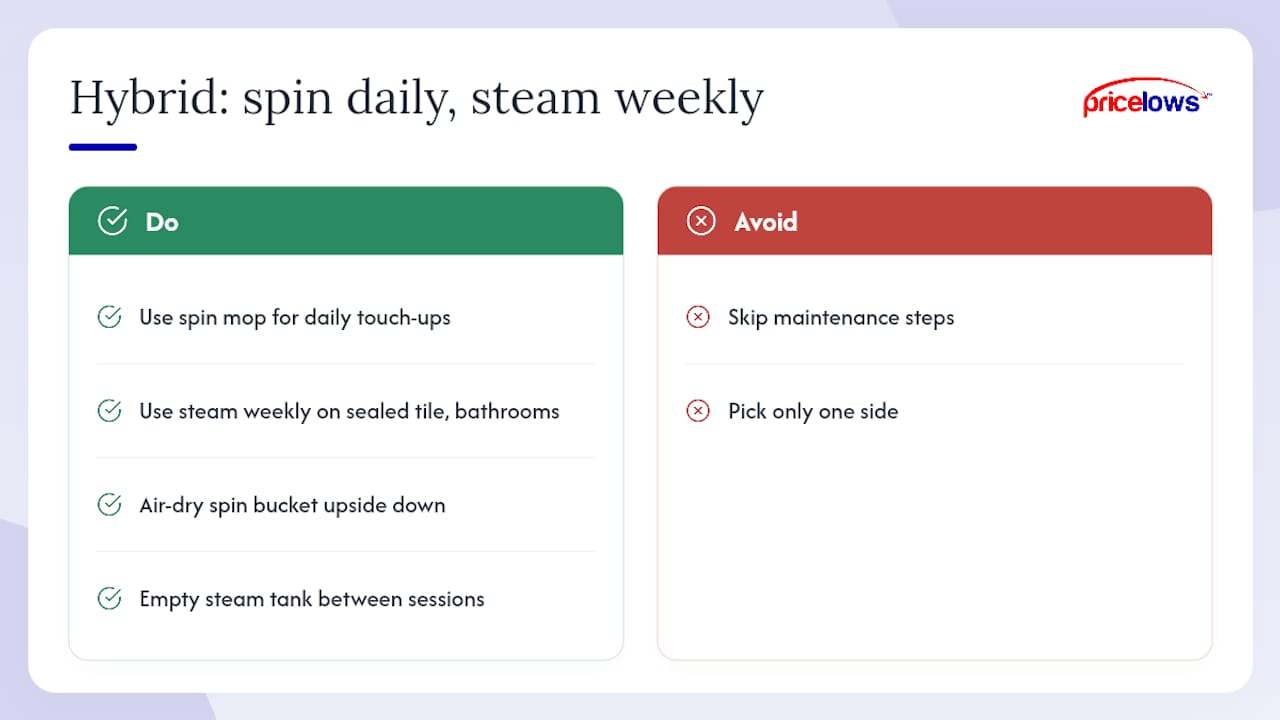
Most homeowners don’t need to pick a side in the steam mop vs spin mop debate. The pragmatic answer is running a spin mop for daily and weekly touch-ups across the whole house, then bringing out a steam mop for a deeper sanitizing pass on sealed tile and bathroom floors once a week.
Keep the habits simple: air-dry the spin mop bucket upside down after each use, empty the steam mop tank between sessions, and rotate mop heads before they start looking flat. Skip these steps and you’ll shorten the life of either tool well before it wears out from actual use.
— Thane Holland
Where to Find the Right Spin Mop at PriceLows™
Once you know your floors call for a spin mop, the real question becomes which bucket size and head count fit your house. PriceLows™ builds its spin mop systems around that exact decision: pick the SKU that matches your square footage and skip paying for tank heaters and steam attachments you’ll never use on laminate or vinyl.

If you’ve got a family home with a mix of tile, laminate, and wood, the 360 Dual-Motion Spin Mop System with its self-cleaning bucket covers the widest range of daily messes. Living in a smaller space? The compact 360 Rotating Head bucket set takes up less closet space without giving up the wringer mechanism that makes spin mops worth owning. For a larger home that needs more mop head rotations between washes, the long-handle 360 Spin System bundle gives you three microfiber heads out of the box.
Sources
- Best mops tested — Serious Eats
- Best spin mops | Better Homes & Gardens
- Steam Mop vs Spin Mop: Which Wins in 2026? | Dreame US
FAQ
What Is Better, a Mop or a Steam Mop?
Neither is universally better. A spin or wet mop handles heavier spills and works safely across more floor types, while a steam mop sanitizes faster and dries quicker on sealed tile and grout.
What Is the Healthiest Way to Mop Floors?
Steam mopping sanitizes without chemical residue, making it a strong option for homes with crawling kids or pets, but only on floors rated for steam. On other surfaces, a spin mop with a natural or enzyme-based cleaner is the safer, healthier choice.
What Floors Should You Not Use a Steam Mop On?
Avoid steam on laminate, luxury vinyl plank, unsealed hardwood, and porous stone, since manufacturers widely warn that heat and moisture can cause swelling, lifted seams, or staining. Sealed tile and grout remain the safest surfaces for steam.
What Are the Downsides of Steam Cleaning?
Steam mops cost more upfront, need an outlet and heat-up time before each use, and are restricted to a narrower range of floor types. They also can’t hold a cleaning solution the way a spin mop’s bucket can, which limits them against greasy or heavily soiled messes.
Is a Spin Mop or Flat Mop Better for Everyday Cleaning?
A spin mop generally beats a basic flat or spray mop for everyday cleaning because the built-in wringer controls moisture more precisely and the bucket lets you mix in a cleaning solution. A flat mop pad, like the washable pads PriceLows™ sells, still works well for quick dry dusting between deeper spin mop sessions.