


Ways to Clean Home With Less Spending in 2026
You can cut your monthly cleaning bill roughly in half starting this weekend. The fastest path: swap most commercial sprays for three pantry ingredients (white vinegar, baking soda, dish soap), consolidate to 5–7 core products, and buy one refillable concentrate. The average American household spends about $40–$70 per month on cleaning supplies, but with a few focused changes, households can reduce this to approximately $15–$30 per month.
Start here — do these five things in the next 90 minutes:
- Audit everything under the sink and pull out duplicates
- Mix one all-purpose spray bottle (50/50 white vinegar and water, a drop of dish soap)
- Swap one roll of paper towels for a microfiber cloth
- Order one refill or concentrate to replace your most-used spray
- Block 30 minutes this weekend to declutter and toss expired products
If you want a vetted starting point, the Starter Home Cleaner Kit from PriceLows™ bundles the core eco tools so you skip the guesswork.
Table of Contents
- What are the best ways to clean home with less spending?
- DIY cleaner recipes that actually save money
- Which inexpensive tools are worth buying vs. what to skip?
- Prevention tactics that cut cleaning time and long-term costs
- How to repurpose household items and stretch your supplies
- Weekly and monthly cleaning templates with time estimates
- Safety, ventilation, and environmental tips for budget cleaning
- Key Takeaways
- Why simplicity beats a shelf full of specialty products
- PriceLows™ starter kits make the switch easier
- Useful sources for further reading
What are the best ways to clean home with less spending?
A focused weekend plan beats a slow, scattered approach. Here are seven steps, each with a realistic time estimate.
- Audit your current supplies (20 min). Pull everything out. Most households keep many cleaning products but only need a handful, and consolidating can eliminate a notable amount of monthly redundant spending.
- Set a 3-month spending target (5 min). Write down your current monthly spend. Aim to cut it by $25–$40 per month. Track receipts in a notes app or a simple spreadsheet.
- Mix your first DIY solutions (15 min). Make an all-purpose spray and a glass cleaner (recipes below). Label both bottles with the date and contents.
- Switch to concentrates or refills where possible (10 min). Concentrated formulas cost significantly less per use than ready-to-spray bottles. A $15 gallon of concentrate can replace $60–$80 worth of spray bottles over six months.
- Bulk-buy staples (15 min online). Buying in bulk at a warehouse store can cut per-unit costs substantially on items like trash bags, dish soap, and laundry detergent. Buying in bulk at a warehouse store is one of the fastest ways to lower cost-per-use without changing any habits.
- Choose your 5–7 core products (10 min). All-purpose spray, glass cleaner, scrub paste, toilet cleaner, dish soap, laundry detergent, and one disinfectant. That covers most household cleaning tasks.
- Set a maintenance cadence (5 min). Pick two 20-minute cleaning windows per week. Consistency beats marathon sessions for both time and product use.
Families who follow all seven steps typically move from the $40–$70 range to $15–$30 per month within the first 90 days.
DIY cleaner recipes that actually save money
These simple recipes match commercial performance for everyday tasks at a fraction of the cost.
| Recipe | Ingredients | Best Surfaces | Avoid On | Cost/Bottle |
|---|---|---|---|---|
| All-purpose spray | 1 cup water, 1 cup white vinegar, 1 tsp dish soap | Counters, sinks, tile | Natural stone (marble, granite) | ~$0.10 |
| Glass cleaner | 2 cups water, ½ cup white vinegar, ¼ cup rubbing alcohol | Windows, mirrors | Tinted glass | — |
| Scrub paste | ½ cup baking soda + dish soap to paste | Tubs, sinks, grout | Polished chrome | ~$0.10 |
| Drain refresher | ½ cup baking soda + ½ cup vinegar, flush with hot water | Drains | N/A | — |
| Stainless steel wipe | A few drops olive oil on microfiber cloth | Appliances, fixtures | Painted surfaces | — |
| Wood polish | 2 tbsp olive oil + 1 tbsp lemon juice | Wood furniture | Unfinished wood | ~$0.10 |
| Degreaser | 2 tbsp dish soap + 2 cups warm water | Stovetop, cabinets | Delicate finishes | ~$0.10 |
Safety rules, non-negotiable:
- Never mix bleach with vinegar or ammonia. The fumes are toxic.
- Label every homemade bottle with contents and the mix date.
- Store DIY cleaners in a cool, dark spot. Most last 2–4 weeks; discard anything that smells off.
- Vinegar is a cleaner, not a disinfectant. For germ-critical surfaces (cutting boards after raw meat, toilet seats, sick-room surfaces), use an EPA-registered disinfectant or a diluted bleach solution per CDC guidance.
Pro Tip: A vinegar-water spray costs roughly $0.10 per bottle versus $4–$6 for a commercial all-purpose spray. Make four bottles at once and store them under the sink — you’ll never run out mid-clean.
Which inexpensive tools are worth buying vs. what to skip?
Eight items that pay for themselves quickly:
- Microfiber cloths — reusable hundreds of times; good technique with microfiber matters as much as the cleaning solution for streak-free results
- Refillable spray bottles — a $2 bottle lasts years; pair with concentrates for maximum savings
- Concentrated cleaner refills — 60–70% cheaper per use than ready-to-spray
- Quality mop with washable pads — the reusable flat mop pads from PriceLows™ replace disposable pads at a fraction of the ongoing cost
- Durable scrub brush — a 3-in-1 scrub brush handles grout, tile, and corners without specialty tools
- Rubber gloves — protect hands and extend the life of your cleaning cloths
- Bulk trash bags — warehouse pricing saves 25–40% versus grocery-store packs
- Vacuum filter — a clean filter maintains suction; replacing it costs $5–$15 versus a new vacuum
Skip: multiple single-surface sprays (bathroom spray, kitchen spray, glass spray). One good all-purpose formula handles all three. Store-brand cleaners perform within about 5% of name brands while costing 30–50% less, so when you do buy commercial, go generic.
When does a starter kit make sense? If you’re starting from scratch or replacing worn-out tools, a kit beats sourcing seven items separately. The Cleanse Bathroom Cleaner Kit from PriceLows™ targets the room most families overspend on, and The Start Up Kit works well for first-time budget buyers who want a curated bundle without hunting for each piece.
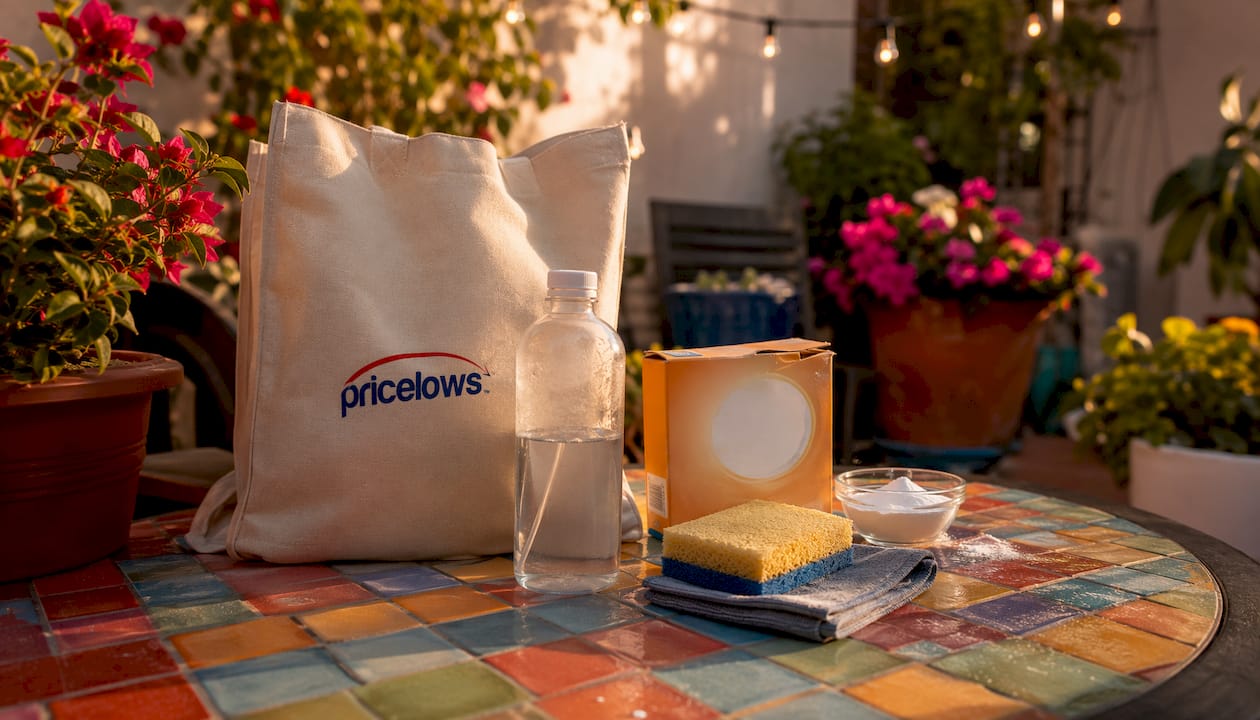
Pro Tip: Most households use 2–3 times the recommended amount of detergent and spray. Following label directions can save money monthly and improve cleaning results by preventing residue buildup.
Prevention tactics that cut cleaning time and long-term costs
Small preventive habits create outsized savings by reducing how often deep cleaning is needed.
- Entry mats on both sides of every exterior door — trap 80% of incoming dirt before it reaches floors
- A no-shoes-inside rule — the single highest-impact habit for reducing floor cleaning frequency
- Vacuum high-traffic zones twice a week — prevents ground-in dirt that requires scrubbing later
- Regular pet grooming — brushing pets outside weekly cuts indoor hair and dander accumulation significantly
- Clean fridge coils every 6 months — dirty coils force the compressor to work harder, raising energy bills and shortening appliance life
- Clear the dryer lint trap after every load — a clogged trap is a fire risk and a dryer efficiency killer
Neglecting fridge coil cleaning can lead to costly service calls or early appliance replacement. Fifteen minutes twice a year prevents that entirely.
Pro Tip: Place a small baking soda box inside your trash can, under the liner. It absorbs odors at the source, which means you clean the can far less often and never need a specialty deodorizer spray.
How to repurpose household items and stretch your supplies
Six repurposes that cost nothing:
- Old cotton T-shirts → cleaning rags. Cut into squares; they outperform paper towels on most surfaces and cost $0.
- Old toothbrushes → grout and faucet scrubbers. The bristle size is perfect for tight spaces.
- Pillowcases → fan blade cleaners. Slip over each blade, pinch, and pull off. Dust stays inside the case, not on your furniture.
- Wool sweater scraps → DIY dryer balls. Roll tightly, secure with old pantyhose, and toss in the dryer. Reduces drying time and eliminates the need for dryer sheets.
- Empty wipe canisters → refillable wipe dispensers. Cut old T-shirt fabric into squares, soak in a DIY solution, and refill the canister.
- Lemon peels → infused vinegar cleaner. Soak peels in white vinegar for two weeks, strain, and dilute 50/50 with water. Cuts grease and smells far better than plain vinegar.
Replacing paper towels with microfiber cloths and repurposed rags can save a family a significant amount annually. The math: a family using two rolls per week at $2 per roll spends roughly $208 annually. Reusable cloths cost $10–$20 once.
Safe thrift tip: When buying used cleaning tools (mops, buckets, brushes), inspect for mold, cracked handles, and worn bristles. Anything that touches food prep surfaces or toilets should be bought new for hygiene reasons. For everything else, secondhand is fine. You can also find bulk household supplies at wholesale prices to stretch your budget further.
Weekly and monthly cleaning templates with time estimates
Weekly cleaning (target: 60–75 minutes total)
| Task | Time | Who |
|---|---|---|
| Wipe kitchen counters and stovetop | 10 min | Any adult |
| Clean toilets and bathroom sinks | 10 min | Rotating |
| Vacuum high-traffic floors | 15 min | Older kids or adults |
| Mop kitchen and bathroom floors | 10 min | Any adult |
| Wipe mirrors and glass surfaces | 5 min | Kids |
| Empty trash cans | 5 min | Kids |
| Quick declutter (counters, tables) | 10 min | Whole family |
Monthly deep-clean checklist
- Clean inside microwave and oven (20 min)
- Wipe cabinet fronts and appliance exteriors (15 min)
- Scrub grout and tile in bathrooms (20 min)
- Vacuum mattresses and flip if needed (15 min)
- Clean fridge interior and wipe coils (20 min)
- Wash shower curtain and bath mats (10 min active, machine does the rest)
- Dust ceiling fans and light fixtures (10 min)
Following this cleaning schedule results in considerably lower monthly supply costs compared to professional biweekly cleaning of a similarly sized home. Over 12 months, this results in substantial cost savings.
Safety, ventilation, and environmental tips for budget cleaning
Never do these:
- Mix bleach with vinegar, ammonia, or hydrogen peroxide
- Use homemade cleaners in unlabeled bottles
- Leave any cleaner within reach of children or pets
- Use strong cleaners in unventilated spaces
For surface disinfection in kitchens and bathrooms, the CDC recommends EPA-registered disinfectants or a properly diluted bleach solution. White vinegar cleans effectively but does not meet the threshold for killing pathogens like Salmonella or norovirus on contact surfaces. Use EPA-registered disinfectants for cutting boards after raw meat, toilet seats, and any surface touched by someone who is sick.
On the environmental side, concentrates and refill systems reduce plastic waste directly. One gallon of concentrate replaces multiple single-use spray bottles. Reusable cloths eliminate paper towel waste. These choices lower both your plastic footprint and your long-term cost.
This article provides general information, not professional safety or medical advice. Always check current CDC and EPA guidance for disinfection standards that apply to your household.
Key Takeaways
Switching to three pantry ingredients, consolidating to 5–7 core products, and buying concentrates can cut a family’s monthly cleaning spend from $40–$70 down to $15–$30.
| Point | Details |
|---|---|
| Switch to pantry staples | White vinegar, baking soda, and dish soap replace most commercial sprays at roughly $0.10 per bottle. |
| Consolidate your product list | Most households need only 5–7 core products; cutting extras saves $10–$20 per month. |
| Buy concentrates and refills | Concentrated formulas cost 60–70% less per use than ready-to-spray bottles. |
| Prevent before you clean | Entry mats, a no-shoes rule, and appliance maintenance reduce cleaning frequency and avoid costly repairs. |
| PriceLows™ starter kits | The Starter Home Cleaner Kit, The Start Up Kit, and Cleanse Bathroom Cleaner Kit give families vetted, affordable tools with free shipping and 100% shipping protection. |
Why simplicity beats a shelf full of specialty products
The cleaning products industry has a financial interest in convincing families that every surface needs its own formula. Bathroom spray, kitchen spray, stainless steel spray, wood spray — it adds up fast, and most of it is redundant.
The families who actually spend the least on cleaning aren’t the ones who found the best coupons. They’re the ones who stopped buying the problem. Three ingredients, a handful of reusable tools, and a consistent 60-minute weekly routine outperform a cabinet full of specialty products every time. The cost data backs this up: Annual cleaning spend drops from $600–$800 to $50–$100 for households that commit to this approach.
One thing worth saying plainly: DIY cleaners are not a replacement for disinfection. Vinegar cleans. It does not disinfect. Knowing the difference keeps your family safe and keeps you from over-relying on a $0.10 bottle when a $2 EPA-registered product is the right call.
PriceLows™ has spent 15 years helping families find tools that hold up without overpaying. The starter kits featured here reflect that same principle: vetted, affordable, and worth the shelf space.
PriceLows™ starter kits make the switch easier
Families who want to skip the sourcing work and start saving immediately, have three strong options at PriceLows™.
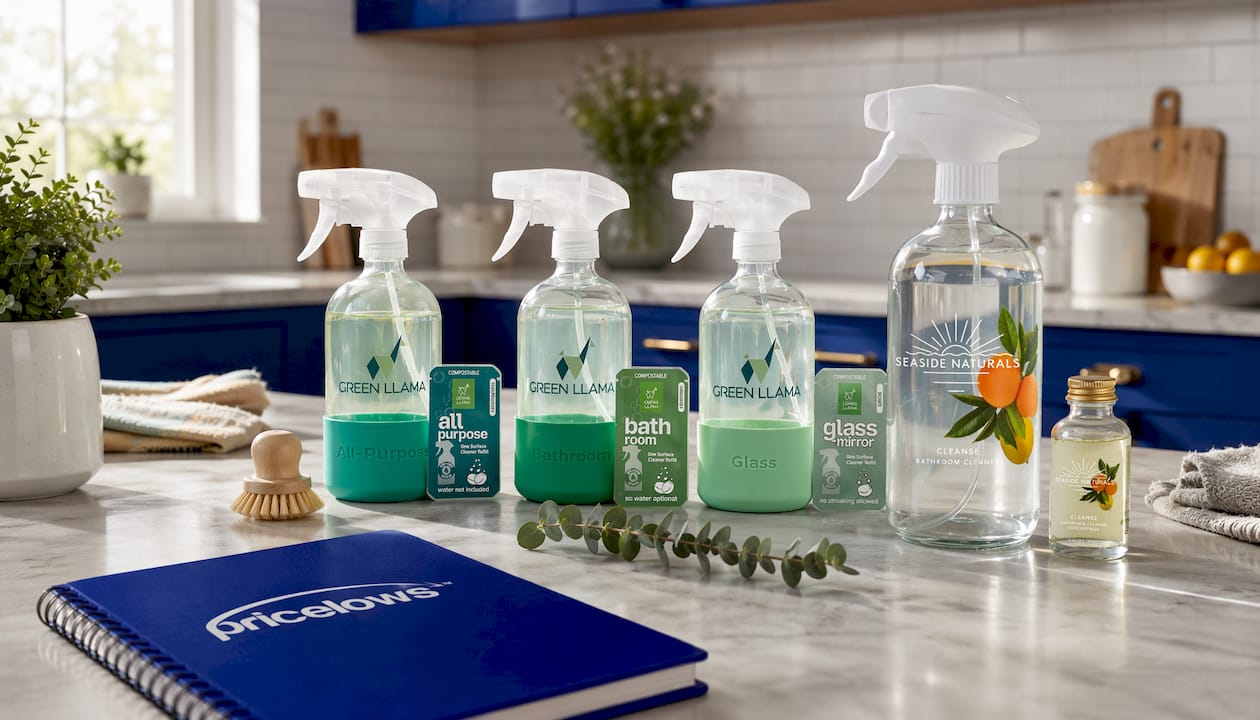
The Starter Home Cleaner Kit is the best fit for households switching from commercial sprays to eco-friendly cleaning. It bundles the core tools in one order, so you’re not piecing together seven separate purchases. The Start Up Kit suits first-time budget buyers who want a compact, curated bundle without the research. The Cleanse Bathroom Cleaner Kit targets the room most families overspend on, giving you a focused solution for the highest-use space in the house.
All three ship free with PriceLows™'s 100% shipping protection plan, so there’s no purchase risk. If you’re ready to stop overpaying for cleaning supplies, browse the affordable cleaning tools at PriceLows™ and pick the kit that fits your home.
Useful sources for further reading
- How to Budget for Cleaning Supplies: A Complete Guide — cost data, consolidation strategies, and concentrate savings math
- Best Budget Cleaning Hacks for Your Home — practical DIY hacks and disinfection guidance
- 5 DIY Cleaning Supplies You Can Make for Pennies — pantry-staple recipes with cost-per-bottle breakdowns
- Eco-Friendly and Budget-Friendly Cleaning Hacks | HGTV — natural ingredient recipes and repurpose ideas
- 22 Genius House Cleaning Hacks | Better Homes & Gardens — technique tips and tool recommendations
- 3-Ingredient DIY Cleaner Spray | CNET — all-purpose spray recipe and surface guidance
- 28 Cleaning Products You Can Make at Home | Home as We Make It — extended recipe library with cost comparisons
- Affordable House Cleaning Tips That Save Money | Green Frog Cleaning — prevention strategies and appliance maintenance tips