


Proper Hand Washing for Cooking: A Home Cook's Guide
Proper hand washing for cooking means soap, running water, and at least 20 seconds of scrubbing at the right moments during food prep. The CDC recommends humming “Happy Birthday” twice as your timer. The moments that matter most: before you start cooking, after touching raw meat, poultry, seafood, or eggs, after using the restroom, after handling trash or pets, and between switching tasks.
- Before touching any food or cooking surface
- After handling raw proteins (chicken, ground beef, shrimp, raw eggs)
- After using the restroom, blowing your nose, or touching your face
- After handling trash, dirty dishes, or pets
- Between switching from raw to ready-to-eat foods
FoodSafety.gov lists this as one of its four core food-safety steps: Clean, Separate, Cook, and Chill. Handwashing anchors the Clean step.
Pro Tip: After washing, use a clean paper towel to turn off the faucet. Touching the handle you grabbed with dirty hands before washing will recontaminate you immediately.
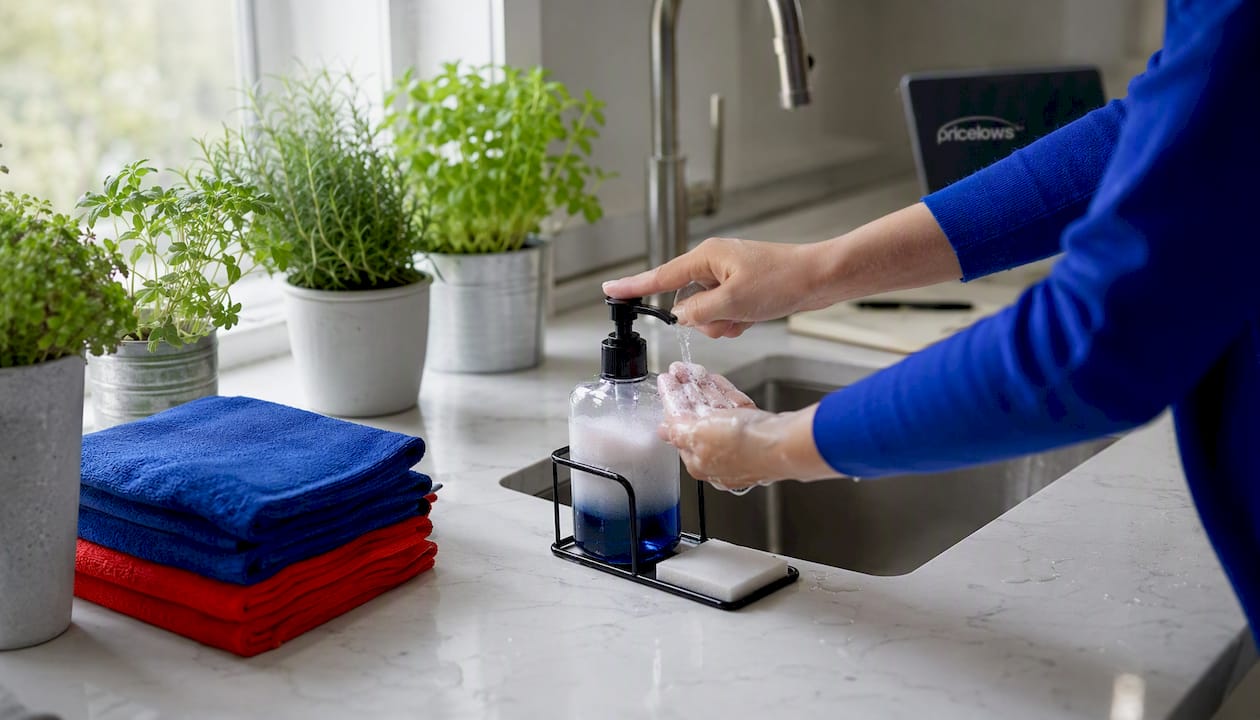
PriceLows™ carries soap dispensers, disposable paper towels, and kitchen sink organizers that keep everything within arm’s reach while you cook.
Table of Contents
- Why does handwashing matter so much in the kitchen?
- When exactly should you wash your hands while cooking?
- How do you wash your hands correctly for cooking?
- Soap and water versus hand sanitizer: which one do you use?
- How should you dry your hands, and do gloves replace washing?
- What kitchen habits make handwashing easier to stick to?
- What are the most common handwashing mistakes during cooking?
- Key Takeaways
- The part most kitchen guides skip
- PriceLows™ has the supplies that make this easier
- Authoritative sources worth bookmarking
Why does handwashing matter so much in the kitchen?
Proper handwashing cuts the primary route for pathogens like Salmonella and E. coli from raw ingredients to ready-to-eat food. Your hands are the transfer vehicle. They touch raw chicken, then the salt shaker, then the salad bowl. Without washing, every surface you contact becomes a contamination point.
An observational study reported that attempts to wash hands correctly failed about 95–97% of the time in home meal-prep settings, most often because people skipped the full 20-second scrub. (CDC)
That number is striking. Most home cooks believe they wash their hands correctly. The observational data says otherwise. The gap is almost never about intent; it is about technique and timing.
Penn State Extension explains why soap alone is not enough: soap’s surfactant properties break down the oily layers that harbor bacteria, but friction from scrubbing is what physically lifts and removes them. Skip either one and the cleaning is incomplete.
| Contamination route | How hands carry it |
|---|---|
| Raw meat to produce | Hands touch raw protein, then salad greens without washing |
| Surfaces to food | Hands touch a contaminated counter, then bread or fruit |
| Person to food | Coughing or nose-touching, then resuming prep without washing |
| Packaging to food | Handling grocery packaging, then touching ready-to-eat items |
When exactly should you wash your hands while cooking?
FSIS guidance is clear: wash before, during, and after food preparation, with specific triggers throughout. Here is how those moments play out in a real kitchen.
Before you start. Even if your hands look clean, they carry surface bacteria from everything you touched since your last wash. Start every cooking session at the sink.
After raw proteins. You trimmed raw chicken and now need to grab the olive oil. Wash first. The juices from raw poultry can carry Salmonella, and they transfer instantly to anything you touch.
After cracking eggs. Raw egg shells carry bacteria on the outside. Crack them, then wash before moving on.
After touching your face or hair. Mid-recipe, you push your hair back or scratch your nose. That counts. Wash before touching food again.
After glove removal. Gloves are not a clean pass. Removing them can transfer whatever was on the outside to your hands. Wash after taking them off.
After interruptions. Phone call, a child needing attention, answering the door. Any break from the kitchen means washing when you return. Your phone screen alone carries more bacteria than most kitchen surfaces.
How do you wash your hands correctly for cooking?
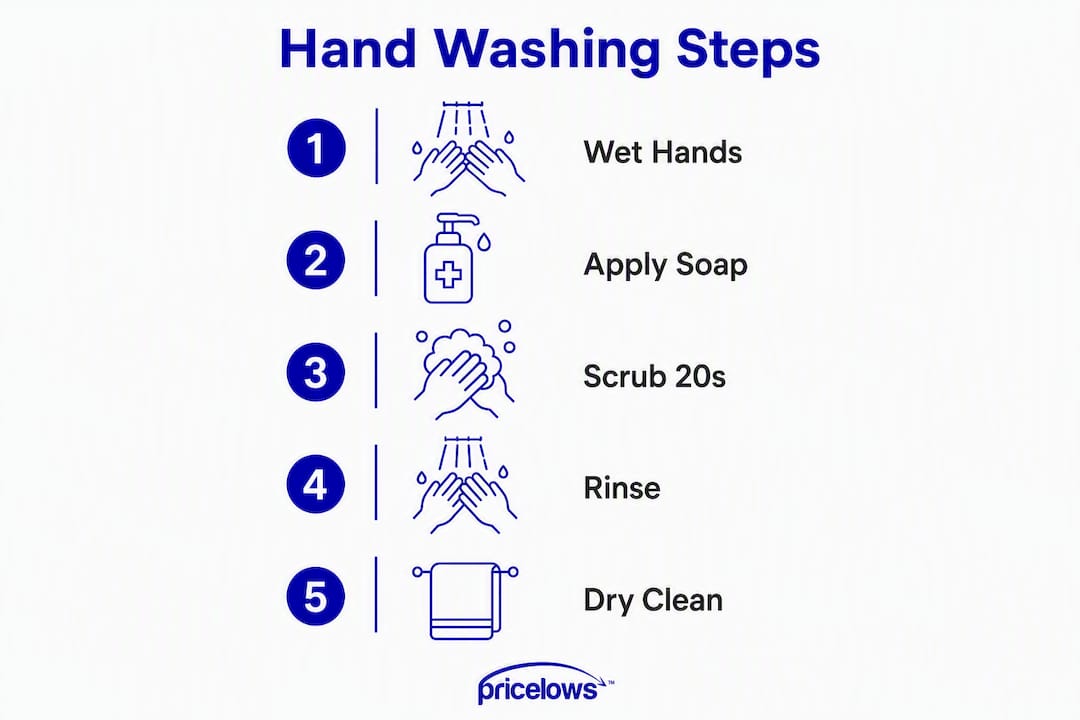
The USDA/FSIS five-step method is the standard. Follow it in this order:
- Wet your hands with clean, running water (warm or cold). Turn off the tap.
- Apply soap and work it into a lather covering both hands completely.
- Scrub for at least 20 seconds. Cover every surface: palms, backs of hands, between fingers, thumbs, fingertips, under nails, and wrists. Hum “Happy Birthday” twice.
- Rinse thoroughly under clean, running water until all soap is gone.
- Dry with a clean single-use paper towel or a clean cloth towel. Use that towel to turn off the faucet.
The areas most people miss: the backs of hands, the webbing between fingers, and under the nails. Those spots harbor the most bacteria and get the least attention. If you wear rings or have long nails, FSIS notes that jewelry and artificial nails significantly increase contamination risk because they trap debris that scrubbing cannot fully reach.
A practical timing habit: tie the 20-second scrub to a specific task cue, like finishing the scrub before you reach for the towel. Some cooks keep a small kitchen timer near the sink for the first few weeks until the habit locks in.
Soap and water versus hand sanitizer: which one do you use?
Soap and water are always the right choice in a kitchen. Hand sanitizer is a fallback, not a replacement.
Illinois Extension sets the threshold clearly: sanitizers need at least 60% alcohol to be effective, and even then they cannot remove visible soil, grease, or food residue. When your hands are coated in raw meat juices, flour, or cooking oil, sanitizer does not cut through the debris. It may reduce some bacterial load on the surface, but it leaves the contaminated material behind.
| Method | Works best when | Limitation |
|---|---|---|
| Soap + water | Always; required after raw proteins, visible soil | Requires a sink and 20 seconds |
| Hand sanitizer (≥60% alcohol) | No sink available, hands not visibly soiled | Cannot remove grease, flour, or raw-protein residue |
The practical rule: if you handled raw meat, fish, eggs, or flour, or if your hands look or feel dirty, only soap and water will do. Sanitizer is for situations like a quick stop between plating courses when your hands are clean but you want an extra layer of protection.
How should you dry your hands, and do gloves replace washing?
Drying matters more than most people realize. Wet hands transfer bacteria more easily than dry ones, so skipping or rushing the drying step undoes part of the wash. A clean single-use paper towel is the standard. Shared cloth towels accumulate bacteria fast in a busy kitchen and can recontaminate hands that were just washed.
Illinois Extension specifically flags the faucet handle as a recontamination risk. You washed your hands, but the handle still has whatever was on them before you started. Use the paper towel to turn it off, then toss the towel.
Gloves are useful for specific tasks but they are not a substitute for handwashing. The rules for gloves in food prep:
- Wash hands before putting gloves on.
- Change gloves when switching between raw proteins and ready-to-eat foods.
- Change gloves after any interruption (phone, touching face, handling trash).
- Wash hands after removing gloves, every time.
A glove that has touched raw chicken carries the same risk as a bare hand that touched raw chicken. The material does not neutralize the pathogen.
Pro Tip: Keep a roll of single-use paper towels and a small waste bin right at the sink. If either requires a trip across the kitchen, you will skip the step. Proximity drives compliance.
PriceLows™ waterproof kitchen gloves are a practical option for dishwashing and raw-handling tasks when you want that extra barrier.
What kitchen habits make handwashing easier to stick to?
The CDC observational data points to a real problem: knowing the steps is not enough. The kitchen environment itself determines whether you actually wash. Design your workflow so washing is the obvious, short action between risky steps.
Zone-based prep is the most effective structural fix. Handle all raw proteins in one area near the sink, then move to a separate zone for produce and ready-to-eat foods. That physical separation creates a natural handwashing checkpoint every time you cross zones.
A few physical changes that make a measurable difference:
- Keep soap and paper towels at the sink, not under the cabinet.
- Use color-coded cutting boards (red for raw meat, green for produce) so task-switching is visible.
- Store raw proteins on the lowest refrigerator shelf, away from ready-to-eat foods.
- Use tongs, scoops, or utensil holders to reduce direct hand contact where possible.
Batch your raw-handling tasks. Trim all the chicken at once, wash hands once, then move to everything else. Stopping and starting repeatedly multiplies the number of times you need to wash, and each interruption is a chance to skip it. For families cooking together, a simple rule works well: “wash when you switch tasks.” Tie it to a visible cue, like changing the cutting board, so it becomes automatic rather than a judgment call.
For broader meal prep workflow tips, organizing your prep sequence around contamination risk is one of the most practical changes you can make.
What are the most common handwashing mistakes during cooking?
Most handwashing failures in the kitchen are not about forgetting entirely. They are about cutting corners on technique.
Not scrubbing for the full 20 seconds. This is the most common error. A quick rinse does not remove pathogens. Set a timer or use the “Happy Birthday” cue until the habit is automatic.
Washing raw meat in the sink. This is a dangerous practice that spreads bacteria rather than eliminating it. Splashing water aerosolizes pathogens and deposits them on surrounding surfaces and utensils. The safe approach is to skip washing raw meat entirely and rely on proper cooking temperatures to kill pathogens.
Not drying with a clean towel. Grabbing the shared dish towel that has been hanging on the oven handle all day recontaminates hands immediately.
Failing to wash after glove removal. Gloves come off, hands feel clean. They are not.
Wearing rings or long nails during prep. Jewelry traps food particles and bacteria in spaces scrubbing cannot reach. Remove rings before cooking when possible.
Under-scrubbing between fingers and under nails. These are the highest-risk spots and the ones most people rush through. Slow down on those areas specifically.
Red flags to watch for in your own kitchen: a wet, dirty sink area after rinsing produce (suggests splashing from raw-protein handling nearby), a shared damp towel near the sink, and touching your phone during prep without washing afterward.
Key Takeaways
Proper hand washing for cooking requires soap, running water, and at least 20 seconds of scrubbing at every critical moment, from before prep begins to after every raw-protein contact.
| Point | Details |
|---|---|
| 20-second scrub rule | Scrub palms, backs, between fingers, under nails, and wrists for at least 20 seconds every time. |
| Critical wash moments | Wash before prep, after raw proteins, after interruptions, and after glove removal without exception. |
| Sanitizer is a fallback | Use hand sanitizer (≥60% alcohol) only when no sink is available and hands are not visibly soiled. |
| Dry with a single-use towel | Use a clean paper towel to dry and to turn off the faucet; shared towels recontaminate washed hands. |
| PriceLows™ for supplies | PriceLows™ offers soap dispensers, paper towels, and kitchen organizers to keep handwashing supplies accessible. |
The part most kitchen guides skip
Most handwashing guides treat this as a knowledge problem. Read the steps, follow them, done. But the CDC observational data tells a different story: the vast majority of people who know the five steps still fail to execute them correctly in a real cooking session. The kitchen is a high-distraction environment. You are watching a timer, managing heat, answering a question from a kid, and somewhere in that chaos, the 20-second scrub becomes a 4-second rinse.
The fix is not more instruction. It is friction reduction. When the paper towels are across the room, you skip drying. When the soap dispenser is buried under the dish rack, you skip lathering. When the cutting board is the same color for everything, you lose track of which tasks require a wash before switching. The physical setup of your kitchen either supports the habit or undermines it.
That is why kitchen organization matters as much as technique. Accessible supplies, visible task separation, and a sink area that is set up for quick, complete handwashing are what turn a five-step method into an automatic behavior. The guidance is simple. The environment is what makes it stick.
PriceLows™ has the supplies that make this easier
Knowing the five steps is one thing. Having the right supplies within arm’s reach is what makes them happen consistently. PriceLows™ carries the affordable kitchen and home essentials that support reliable handwashing routines: soap dispensers, disposable paper towels, cutting board sets, and storage organizers that keep your sink area functional and clean.

For home cooks who want to go further with storage, the Rolling Garage Tool Cabinet and the 6-Piece Garage Storage Cabinet Set with a rubberwood worktop are built for households that stock cleaning supplies in bulk. Both ship free with PriceLows™'s 100% shipping protection plan. Browse the full selection at PriceLows.com and stock your kitchen the right way.
Authoritative sources worth bookmarking
- CDC: Handwashing as a Healthy Habit in the Kitchen — the observational research on handwashing failures and the five-step technique
- FoodSafety.gov: 4 Steps to Food Safety — Clean, Separate, Cook, Chill framework with handwashing timing guidance
- USDA/FSIS: Handwashing for Food Safety — the procedural authority for the five-step method and nail/jewelry guidance
- Illinois Extension: Hand Washing and Food Safety — sanitizer thresholds and faucet recontamination guidance
- Penn State Extension: Proper Handwashing Procedures — the science behind soap and friction working together
- PriceLows™ Kitchen Hygiene for Kids — practical guide for teaching handwashing habits to children in the kitchen
For commercial kitchens and food-service workers, ServSafe certification covers hand hygiene as part of its food handler training and is the industry standard in the United States.
This article provides general food-safety information. For specific guidance on your situation, consult the USDA, CDC, or a certified food-safety professional.