


Why Ventilation Matters in Your Hobby Space
Proper ventilation in hobby spaces is non-negotiable for your health, your tools, and your home’s structural integrity. Solvents and paints release volatile organic compounds (VOCs) that accumulate fast in enclosed rooms. Fine dust from sanding or cutting fabric fibers can reach your lungs before you notice the air has changed. Humidity from inadequate airflow causes rust on cast-iron surfaces, warps wood, and breaks down adhesives over time. The fix starts with three immediate actions:
- Open windows or doors on opposite sides of the room to create crossflow before you start any work.
- Run an exhaust fan or window fan pointed outward during the session.
- Keep a HEPA/activated carbon air cleaner running as background filtration.
Pro Tip: Run your exhaust fan continuously while using solvents or glue, then keep it running for 30 minutes after you finish to clear residual fumes that linger even after the work stops.
Planning your space from the start makes ventilation simpler. Dedicating a specific area for messy or fume-producing tasks reduces cross-contamination in living areas and lets you design airflow around one room rather than retrofitting an entire floor.
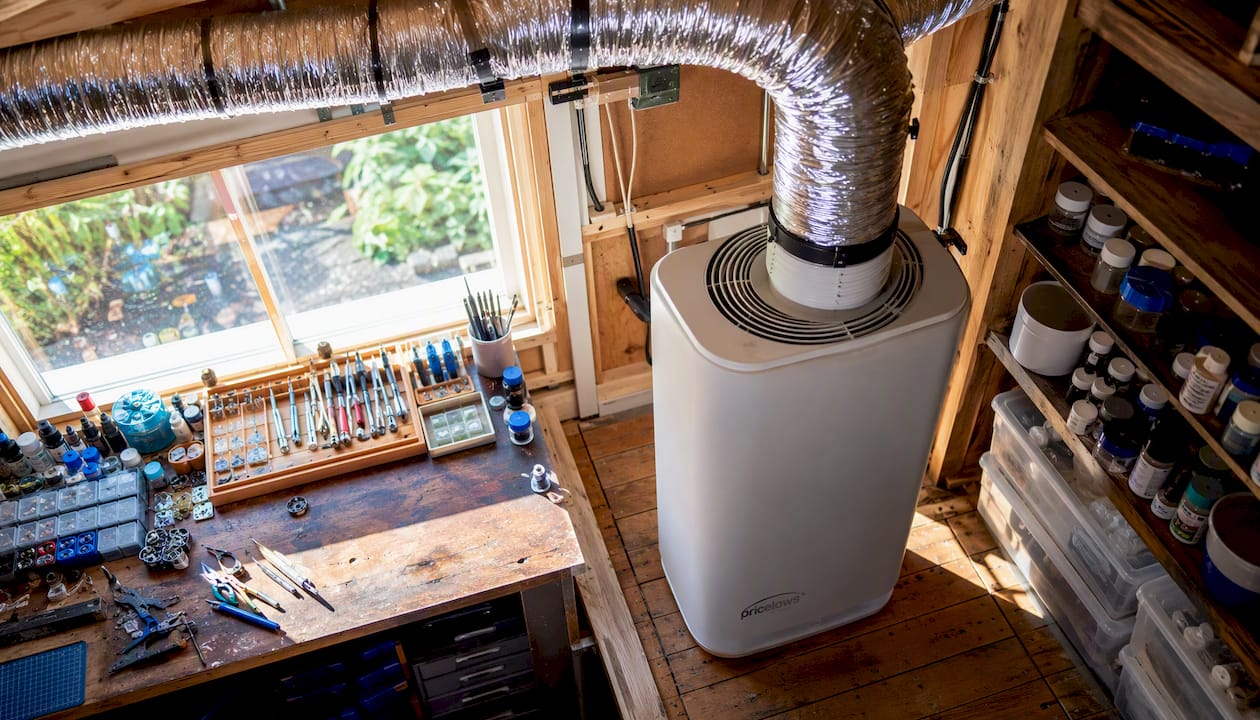
Table of Contents
- How ventilation creates a healthier hobby space
- How ventilation affects comfort, temperature, and energy use
- How ventilation protects your tools and stored materials
- Safety risks in hobby spaces and how ventilation reduces them
- What types of ventilation work best for hobby spaces?
- How much ventilation do you need and where should it go?
- How to keep your ventilation system working over time
- What to do right now to improve your hobby space air
- Key Takeaways
- The part most hobbyists skip entirely
- PriceLows™ has the storage to complete your hobby space setup
- Useful sources and further reading
How ventilation creates a healthier hobby space
Ventilation reduces your exposure to airborne hazards by diluting contaminants with fresh air and, when done right, capturing them before they ever reach your breathing zone.
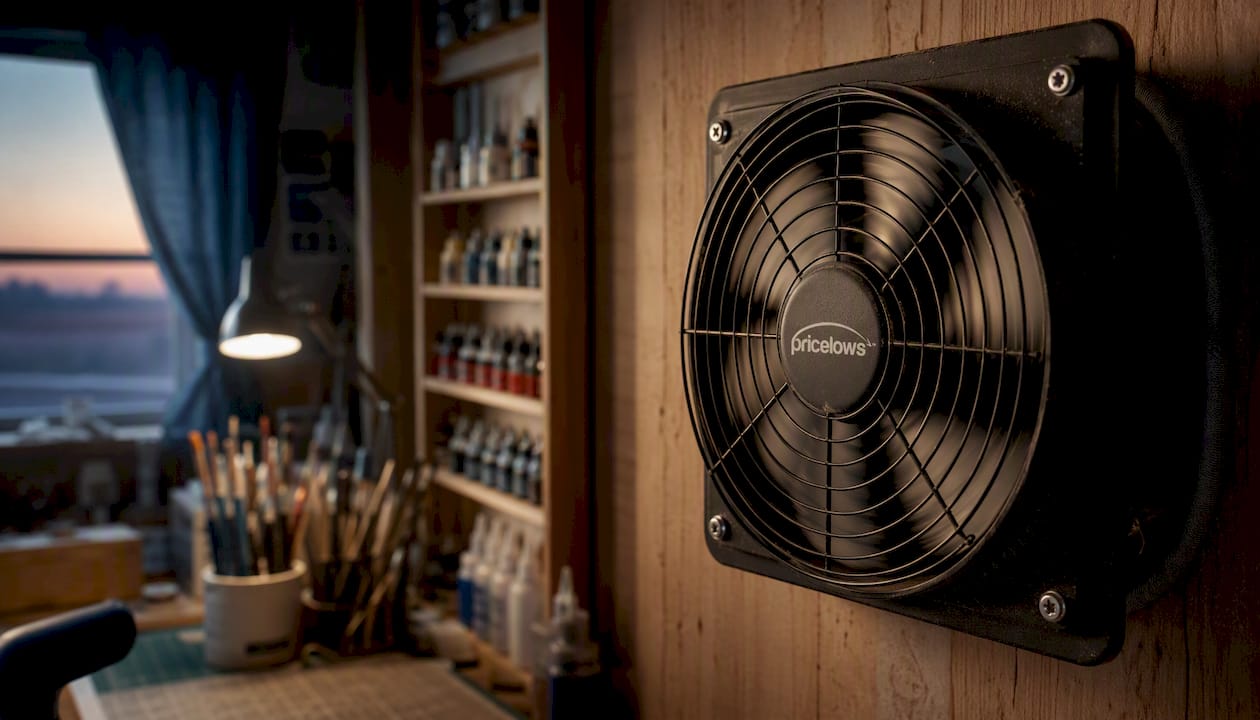
Two distinct mechanisms are at work. General ventilation floods the room with fresh air, diluting whatever is already airborne. Local exhaust ventilation (LEV) pulls contaminants directly from the source, a sanding table or spray booth, before they disperse. LEV is more effective per cubic foot of air moved and often uses less energy because it targets the problem rather than treating the whole room.
Common hobby pollutants fall into three categories:
- VOCs from oil-based paints, lacquers, epoxy resins, and contact cement. These are invisible and odorless at low concentrations, which is exactly what makes them dangerous.
- PM2.5 and respirable dust from woodworking, drywall sanding, ceramic work, and even cutting synthetic fabrics. Particles below 2.5 microns bypass your nose and throat entirely.
- CO2 and combustion byproducts from propane torches, unvented kerosene heaters, or even a gas-powered compressor running in a sealed garage.
The EPA notes that indoor air quality in poorly ventilated spaces can be up to five times more polluted than outdoor air — a gap that widens sharply when chemicals or dust are present.
Ventilation alone handles moderate exposures well. For heavy solvent work, spray painting, or sustained dust generation, pair it with a respirator rated for the specific hazard. Airflow reduces the load; it does not eliminate it entirely.
How ventilation affects comfort, temperature, and energy use
Good airflow makes a hobby room more comfortable to work in, but raw exhaust ventilation trades conditioned air for fresh air, and that costs money in heating and cooling seasons.

The practical solution for year-round hobby spaces is an energy recovery ventilator (ERV) or heat recovery ventilator (HRV). Both pre-condition incoming air by transferring heat between outgoing and incoming airstreams, so you get fresh air without dumping your heating or cooling budget out the window. ERVs also transfer moisture, which helps maintain stable humidity in dry winters. HRVs are better suited to humid climates where you want to exhaust moisture rather than recirculate it.
For hobbyists who work seasonally or only a few hours a week, a simpler approach works fine:
- Open windows when outdoor temperatures are within 10–15°F of your target indoor temperature.
- Use a timed exhaust fan set to run during and shortly after work sessions rather than continuously.
- In summer, ventilate in the early morning before heat builds; in winter, pre-heat the space before opening any fresh-air path.
Pro Tip: Pair a programmable outlet timer with your exhaust fan. Set it to run 30 minutes before you start and 30 minutes after you stop. You get clean air when it matters and avoid conditioning costs the rest of the day.
HVAC professionals consistently point out that homeowners fear ventilation will spike energy bills. A properly specified ERV or HRV addresses that concern directly by recovering most of the thermal energy that would otherwise be lost.
How ventilation protects your tools and stored materials
Airflow is not just about what you breathe. It directly determines how long your tools last and whether your materials stay usable.
Dust holds moisture. A fine layer of sawdust or sanding residue on a cast-iron machine table acts like a sponge, keeping the surface damp long after the humidity in the room drops. That sustained contact accelerates surface rust. The same moisture cycling that rusts metal causes solid wood to expand and contract, warping boards and stressing glue joints. Adhesives stored in a room with wide humidity swings degrade faster, and finishes cure unevenly when humidity is too high.
Practical prevention by hobby type:
- Woodworking: Run ambient air filtration continuously, not just during cutting. Fine dust settles on everything, including your jointer tables and router bits.
- Sewing and fabric crafts: Synthetic fibers shed microscopic particles that cling to machine parts. An ambient HEPA filter near the machine reduces buildup inside the bobbin case and feed dogs.
- Painting and finishing: Control humidity at the finishing station. High humidity causes blush (milky haze) in lacquers and slows cure times in water-based finishes.
A dehumidifier paired with spot ventilation at your finishing station handles most of these risks. For moisture-resistant material choices in garages, the principle is the same: remove moisture at the source before it reaches your equipment.
Safety risks in hobby spaces and how ventilation reduces them
Ventilation cuts three categories of acute risk: fire and explosion from flammable vapors, respiratory damage from fine dust, and carbon monoxide (CO) poisoning from combustion sources.
Each hazard maps to a specific control:
- Solvent and aerosol fumes (lacquer thinner, spray paint, contact cement) → continuous exhaust ventilation rated for flammable vapors; no spark-producing switches or motors inside the room during use.
- Fine wood or composite dust → LEV at the cutting source plus ambient HEPA filtration to catch what escapes.
- CO from propane heaters, gas compressors, or combustion tools → direct exhaust to outside plus a CO detector with an audible alarm.
- Resin and epoxy fumes → sealed work area with negative-pressure exhaust and activated carbon filtration.
The EPA reports that indoor air in spaces with chemical use can reach pollutant levels up to five times higher than outdoor air — a threshold that puts solvent-heavy hobby sessions squarely in hazardous territory without active exhaust.
One underappreciated risk: pulling air out of a room without providing a replacement path creates negative pressure. That pressure difference can draw fumes from adjacent spaces — a furnace room, an attached garage — back into your hobby area. Always provide a controlled intake path when running mechanical exhaust.
Pro Tip: When working with solvents near any heat source, sequence your steps: ventilate first, then introduce the solvent, and never run a combustion heater in the same room at the same time. Treat the two as mutually exclusive.
What types of ventilation work best for hobby spaces?
The right system depends on your hobby’s risk level, your room’s size, and your budget. Here is a practical breakdown.
| Type | Scope | Typical ACH | Pros | Cons | Cost/Complexity |
|---|---|---|---|---|---|
| Natural (cross-ventilation) | Whole room | 1–4 | Zero cost, simple | Weather-dependent, unreliable | Low |
| Mechanical general (exhaust fan) | Whole room | 4–10 | Affordable, controllable | Loses conditioned air | Low–Medium |
| Local exhaust (LEV) | Point source | N/A (source capture) | Most effective per CFM | Requires ductwork or flexible arm | Medium |
| Ambient air cleaner (HEPA/carbon) | Whole room | Supplement only | Catches residual fine dust/VOCs | Not a substitute for exhaust | Low–Medium |
| ERV/HRV | Whole house or room | 4–8 | Energy-efficient, year-round | Higher upfront cost | High |
Cross-ventilation through windows on opposite walls works well for low-risk tasks like hand sewing, light assembly, or reading plans. The moment you introduce solvents, power tools, or aerosols, you need mechanical exhaust.
Hobby-to-ventilation matches:
- Painting or finishing → LEV at the spray area plus an ambient air cleaner with both HEPA and activated carbon stages.
- Woodworking → LEV at the saw or sander plus continuous ambient filtration for fine dust that escapes capture.
- Sewing or fabric crafts → ambient HEPA filter near the machine plus intermittent exhaust when pressing with steam.
- 3D printing or electronics → enclosure with active exhaust and activated carbon filtration for ultrafine particles and VOCs.
On filtration media: HEPA captures particles down to 0.3 microns but does not reduce VOC concentrations unless the unit also includes a substantial activated carbon stage. If you work with paints, glues, or solvents, verify that your air cleaner has both. A HEPA-only unit will not touch chemical fumes.
For spaces built into attics or garages, understanding how roofing ventilation systems interact with your hobby room’s airflow can prevent pressure imbalances that undermine your exhaust setup.
How much ventilation do you need and where should it go?
Start with air changes per hour (ACH), the number of times your room’s total air volume is replaced each hour. The formula is straightforward:
CFM = (Room Volume in cubic feet × Target ACH) ÷ 60
Two worked examples:
- 10 × 12 × 8 ft room (960 cu ft), general crafting at 6 ACH: 960 × 6 ÷ 60 = 96 CFM
- 20 × 20 × 10 ft workshop (4,000 cu ft), woodworking at 8 ACH: 4,000 × 8 ÷ 60 = 533 CFM
ACH targets by task, based on industry guidance for hobby and workshop spaces:
- General light crafts (hand sewing, model assembly): 4–6 ACH
- Woodworking and power tools: 6–10 ACH
- Aerosol spraying or heavy solvent use: 10–12 ACH
- Resin casting or epoxy work: 10–12 ACH, plus source capture
Placement rules:
- Place exhaust at or near the pollutant source. For heat and VOCs, high on the wall or ceiling. For heavy vapors (most solvents are denser than air), low on the wall.
- Position the intake on the opposite side of the room to encourage crossflow rather than short-circuiting.
- Set a standalone air purifier at breathing height, roughly 3–4 feet off the floor, away from walls.
ASHRAE’s residential ventilation guidance establishes that whole-home ventilation should provide a minimum of 0.35 air changes per hour — hobby spaces with active chemical or dust generation need far more than that baseline.
Pro Tip: Balance your intake and exhaust. If you pull 400 CFM out and have no dedicated intake path, the room goes negative and pulls air from wherever it can find it — under doors, through wall gaps, from adjacent rooms. A simple passive vent or a small intake fan on the opposite wall solves this.
How to keep your ventilation system working over time
A fan with a clogged filter moves a fraction of its rated CFM. Maintenance is what separates a system that works from one that just looks like it does.
Routine maintenance schedule:
- Monthly: Wipe fan blades and grilles; check that exhaust dampers open freely.
- Quarterly: Replace or wash air cleaner pre-filters; inspect HEPA and carbon filter condition (most units have indicator lights, but check visually too).
- Annually: Inspect ductwork for gaps or blockages; clean ERV/HRV cores per manufacturer instructions; test CO and smoke detectors.
What to monitor and when to act:
| Metric | Threshold to act | Affordable monitor |
|---|---|---|
| CO2 | Above 1,000 ppm during work | Aranet4, CO2Meter.com units |
| PM2.5 | Spike above typical PM2.5 safety thresholds | IQAir AirVisual, Temtop |
| VOC index | Sustained elevated readings | Awair Element, Govee air quality monitor |
| Relative humidity | Below 30% or above 60% | Any digital hygrometer |
Consumer-grade monitors in the $50–$200 range give you real numbers rather than guesses. A CO2 reading above 1,000 ppm during a work session tells you the room needs more fresh air, not just filtration. PM2.5 spikes that persist after you stop cutting mean your LEV or ambient filter is undersized or overdue for a filter change.
Run ambient air cleaners during work and consider continuous background filtration for fine dust even when the primary dust-producing tool is off. Fine particles stay airborne for hours after the source stops.
What to do right now to improve your hobby space air
Three immediate actions cover most of the risk: assess what you are actually producing, ventilate during every work session, and run a post-work purge.
Prioritized checklist with time and cost estimates:
- Open windows and create crossflow — $0 / 5 minutes. Do this before every session, even in winter.
- Buy and install a window exhaust fan — roughly $30–$80 / 1 hour. Points outward; runs during work and 30 minutes after.
- Add a HEPA/activated carbon air cleaner — roughly $150–$500 depending on room size. Run continuously during work sessions.
- Install a CO detector with audible alarm — roughly $20–$40. Required if you use any combustion heat source or gas-powered tool.
- Pick up a basic air quality monitor — roughly $50–$150. Gives you real PM2.5 and CO2 readings so you know when ventilation is actually working.
- Set up local exhaust at your primary work surface — cost varies by setup. A flexible-arm duct connected to a shop vacuum or inline fan is a weekend project.
Pro Tip: A cordless handheld vacuum used at the end of every session removes settled dust before it can hold moisture overnight. It takes three minutes and extends the life of your tools and surfaces.
Even with good ventilation, wear a respirator rated N95 or higher for dust-heavy tasks, and a half-face respirator with organic vapor cartridges for solvent or spray work. Ventilation reduces the load; a respirator handles what remains.
Key Takeaways
Proper ventilation in hobby spaces protects your health from VOCs and fine dust, preserves tools from humidity-driven rust and warping, and reduces fire and CO risks from flammable vapors and combustion sources.
| Point | Details |
|---|---|
| Health protection | Indoor air can be up to five times more polluted than outdoor air in spaces with chemical or dust use. |
| ACH targets by task | Target 4–6 ACH for light crafts, 6–10 for woodworking, and 10–12 ACH for aerosol or heavy solvent work. |
| Tool and material preservation | Dust holds moisture and accelerates rust on metal surfaces; humidity swings warp wood and degrade adhesives. |
| Monitor and maintain | Watch CO2 (act above 1,000 ppm), PM2.5, and relative humidity (keep 30–60%); replace filters quarterly. |
| PriceLows™ storage solutions | Pair ventilation with sealed, rust-resistant storage from PriceLows™ to protect tools from dust and humidity between sessions. |
The part most hobbyists skip entirely
Most ventilation advice stops at “open a window” or “buy an air purifier.” That is fine for someone who occasionally glues a model kit. It is genuinely dangerous for anyone doing regular solvent work, spray finishing, or sustained power-tool use in an enclosed room.
The piece that gets skipped is balance. Exhaust without intake creates negative pressure. Negative pressure pulls air from wherever the house offers a path, which can mean drawing furnace exhaust or garage fumes into your workspace. A $30 passive vent on the opposite wall prevents this entirely. Yet almost no general ventilation guide mentions it.
The second overlooked point: HEPA alone does not protect you from chemical fumes. A HEPA purifier running during a lacquer session gives you a false sense of security. The particles are captured; the VOCs pass straight through. You need activated carbon in the same unit, and enough of it to matter. Thin carbon pre-filters in budget purifiers are largely decorative at typical hobby-room VOC concentrations.
Ventilation is also a tool-preservation investment, not just a health measure. The hobbyists who treat it that way, who run filtration continuously and control humidity year-round, consistently get more years out of expensive equipment. That framing tends to motivate action faster than abstract health warnings.
PriceLows™ has the storage to complete your hobby space setup
Better ventilation moves dust and fumes out. Sealed, organized storage keeps them from accumulating in the first place. PriceLows™ carries the storage solutions that make a ventilated hobby space actually work.

The Rolling Garage Tool Cabinet | Lockable Steel Storage Chest | Powder Coated Rust Resistant Finish keeps tools sealed away from airborne dust and humidity between sessions. Its powder-coated finish resists the surface rust that poor ventilation accelerates. The Garage Storage Cabinet | 3-Point Locking System | Wheels And Locking Doors | Standard locks hazardous materials, solvents, and aerosols away from heat sources and out of reach. For a complete setup, the Garage Storage Cabinet Set | 6 Piece | Metal Construction With 1in Rubberwood Worktop | Black And Red Finish gives you a full workstation with enclosed storage, a rubberwood worktop, and rolling chests, everything organized and off the floor where moisture collects. All orders ship free with PriceLows™'s 100% shipping protection plan. Browse the full garage hobby space setup guide to see how storage and ventilation work together.
Useful sources and further reading
- EPA: Introduction to Indoor Air Quality — the primary U.S. government resource on indoor pollutants, sources, and health effects. Start here for authoritative context.
- EPA: A Brief Guide to Mold, Moisture, and Your Home — covers humidity control and mold prevention, directly relevant to hobby spaces with moisture-generating activities.
For system design beyond a basic fan-and-filter setup, consult a licensed HVAC professional. Consumer air quality monitors give you real measurements to validate that your setup is actually working. This article provides general information; confirm current standards and any code requirements with a qualified professional or your local building department.